Brazil Sours The Mood...

Updated: 10 minutes ago
BentinPartner Weekly

Dear Reader,
Please find below our latest Weekly Trend Report.
Have a nice start of the week.
Marc Bentin,
Bentinpartner GmbH
Last week’s troubles actually began with the turmoil that hit Brazilian financial markets following the surprise comeback and victory of Lula da Silva in the second round of Brazil’s presidential election. This triggered a sharp sell-off across the Brazilian currency (-9%), bond (+230bps) and equity markets (-13% in a single session), translating into an immediate 20% one-day loss on a sensible equity diversification trade (which yours truly had embraced) that had, until then, been one of the year’s best performers.
The real surprise was perhaps that this precipitous sell-off failed to spread to other financial markets and certainly not to US assets, where sentiment remained buoyant during the first half of the week. Investors were encouraged by the excitement surrounding Anthropic’s announcement that it would proceed with a record USD 2 trillion IPO, while also anticipating a Fed meeting unlikely to deliver further tightening and looking optimistically toward upcoming Mega Cap Tech earnings.
Early in the week, sentiment in EU sovereign debt markets also improved following Moody’s unexpected decision not to downgrade French sovereign debt, with the OAT/Bund spread narrowing to 154bps (-14bps).
Sentiment was further supported ahead of Wednesday’s Fed meeting by Meta’s USD 98bn equity raise, reportedly “five times oversubscribed” (which we immediately denounced as yet another Zuckerberg rip-off, given that the issuance involved non-voting shares designed to raise capital without calling it debt or diluting the founder’s voting control). The Kospi Index also rallied strongly early in the week, with neo-cloud names CoreWeave and Nebius staging a 10% dead-cat bounce. ORCL, poster child of many AI-related excesses, also rallied 12%, while credit spreads on these names tightened for two consecutive days.
This rosy backdrop began to be challenged shortly after Wednesday’s close when GOOG shed 10% in overnight trading after disclosing AI-related exposure approaching USD 1 trillion, widening cash burn, and plans for a significant increase in capex by 2027, despite disappointing advertising revenues, one of its key sources of income. The announcement delivered a shock regarding the affordability, monetization, and sustainability of the company’s long-term AI investment strategy.
Several other AI-related companies also dropped 15%-20% overnight, causing the technology rally to derail on Thursday and catching investors wrong-footed after the strong recovery witnessed earlier in the week. That said, selling pressure remained relatively muted at the index level, with semiconductors down only 1.4%, while sentiment remained resilient as MSFT exceeded expectations and rallied despite Google’s sell-off. Microsoft's performance was further supported by a highly successful USD 25bn bond offering.
However, after Thursday’s close, INTC suffered an even steeper decline than GOOG, plunging 25%, while AMZN lost 7% overnight. This effectively wiped out the remaining enthusiasm that had characterized the start of the week, prompting investors to rotate into more defensive, value-oriented sectors such as consumer staples and healthcare.
The hacking of Binance did little to help sentiment in crypto markets, but gold and silver offered no shelter either, as investors were forced to deleverage and take profits wherever possible. The technical picture for gold, and even more so for silver, continued to deteriorate with a reverse head-and-shoulders pattern approaching, alongside a breach of the 200-day moving average and the increasingly important USD 4,000 support level.
That level was broken overnight on Thursday, triggering a further 3% decline in gold on Friday and making precious metals among the biggest casualties of last week’s risk-off liquidation episode. According to a Goldman Sachs report published this weekend, the sell-off in precious metals may become worth buying at some stage, although perhaps not yet in the short term.
Friday began with the Kospi down 3.5%, and the remainder of the day delivered a brutal session across equities, credit and precious metals. Government bonds, however, acted for once as a genuine safe haven. Concerns around EU sovereign debt also resurfaced, with the OAT/Bund spread widening by 9bps on Friday, although it still ended the week modestly lower overall.
Credit concerns remained concentrated in technology credit and high yield markets more broadly. European credit funds are also nursing increasingly painful losses. Arini’s flagship fund, one of Europe’s fastest-growing hedge funds which expanded from EUR 1bn in 2022 to EUR 22bn, fell 12% in October and is down 26% so far in 2026. Nvidia CDS widened by 16bps on Friday to 81bps, compared with 40bps in June.
On Friday, S&P revised Meta’s outlook to negative, citing growing pressure on the company’s balance sheet and noting that Meta’s ability to monetize its AI investments appears more limited than that of its peers.
Returning to Wednesday’s Fed meeting, while the Fed ultimately left rates unchanged, several officials reiterated the need for further tightening. Such hikes appear increasingly unlikely should financial conditions continue to deteriorate. Market-implied odds of a December rate increase fell to 73%, down from 91% at the beginning of the week. Attention is therefore likely to shift toward the newly established Fed “Balance Sheet Task Force,” while hopes remain that additional short squeezes may provide opportunities for investors still seeking to reduce leverage.
Interestingly, no “Trump Put” emerged last week ahead of this week’s Midterm elections. This may reflect a growing realization that the equity market rally is not only stalling but has disproportionately benefited a small and increasingly concentrated group of investors through the expansion of the AI bubble, making it a less attractive political asset.
Markets became a minefield last week, and that situation is unlikely to improve in the near term. Risks remain elevated because of the possibility of a Blue Sweep, mounting concerns over a renewed Iranian conflict following the election, persistent tensions surrounding EU social and sovereign debt dynamics, and the continued lack of progress on the Russian front.
One may also argue that a portion of the funds allocated to support an already lost and seemingly endless war, along with its associated corruption, in Ukraine could instead be redirected toward addressing some of the root causes of the increasingly violent social unrest spreading throughout Europe. At its core, this unrest reflects a chronic affordability crisis that governments struggle to tackle due to limited fiscal flexibility.
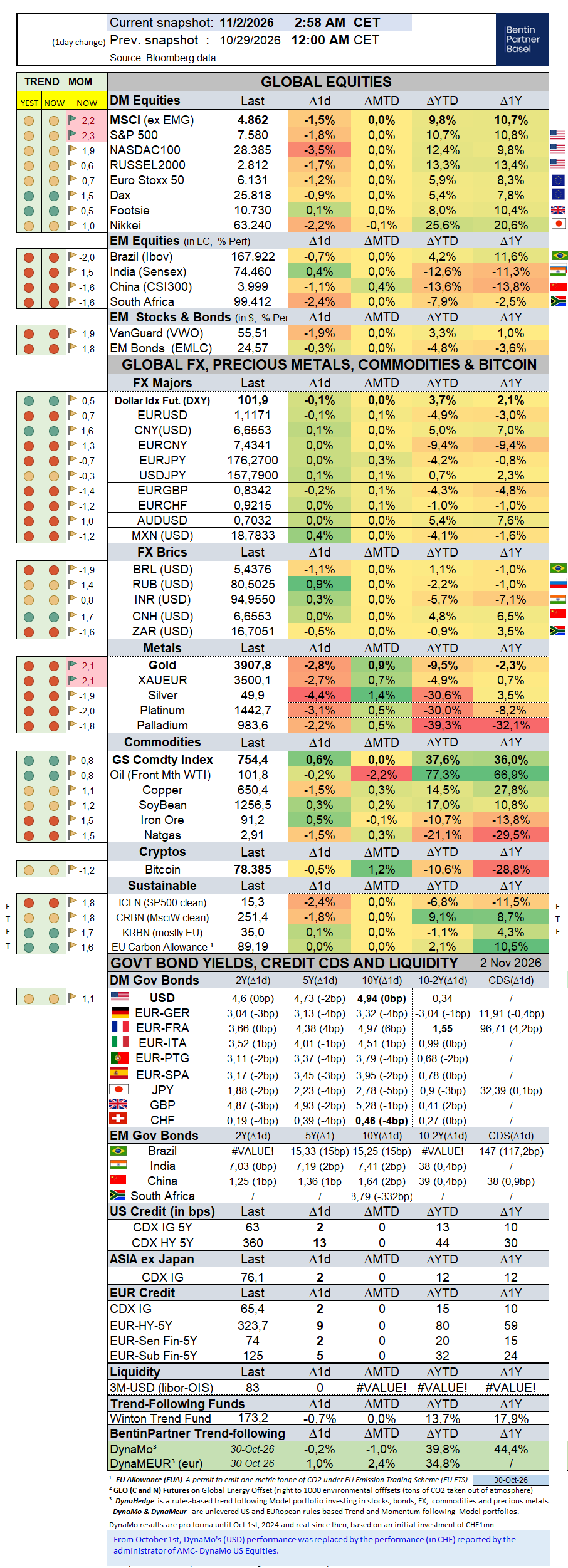
Over the past week, the S&P500 dropped -0,6% (10,8% YTD, Z-score -2,3) while the Nasdaq100 dropped -2,0% (12,4% YTD). The US small cap index gained 1,3% (13,5% YTD). AAPL dropped -0,9% (26,8%).
The Equally Weighed SP500 gained 0,8% (14,0% YTD), outperforming the S&P500 by 1,4%. The median SP500 YTD return closed the week at 10,1%.
Cboe Volatility Index dropped -0,2% (29,9% YTD) to 19,42.
The Eurostoxx50 gained 1,1% (8,1%), outperforming the S&P500 by 1,7%.
Diversified EM equities (VWO) sold off by -2,3% (3,3%), underperforming the S&P500 by-1,8%.
The Dollar DXY Index (UUP) measuring the USD performance vs. other G7 currencies gained 0,1% (7,3%) while the MSCI EM currency index (measuring the performance of EM currencies vs. the USD) dropped -0,1% (3,8%).
10Y US Treasuries rallied -5bps (77bps) to 4,94%. 10Y Bunds dropped -2bps (47bps) to 3,32%. 10Y Italian BTPs rallied -6bps (96bps) to 4,51%, outperforming Bunds by -4bps.
10Y French OAT's rallied -5bps (141bps) to 4,97%, outperforming Bunds by -3bps.
US High Yield (HY) Average Spread over Treasuries climbed 3bps (74bps) to 3,40%. US Investment Grade Average OAS climbed 1bps (17bps) to 1,01%.
In European credit markets, EUR 5Y Senior Financial Spread dropped -2bps (20bps) to 0,74%.
Gold sold off by -2,7% (-9,5%, Z-score -2,1) while Silver sold off by -7,6% (-30,4%). Major Gold Mines (GDX) sold off by -3,9% (-10,1%, Z-score -2,4).
Goldman Sachs Commodity Index dropped -1,4% (50,3%). WTI Crude gained 0,1% (77,4%).
Overnight in Asia…
S&P future +35 points; Hong Kong +0.6%; Nikkei+0.3%; China +1.3%
Asian stocks rebounded slightly, same as last week at the same time, supported by “lower” (than peak) oil prices. Gold rebounded 1%.
Chinese stocks advanced following a report that financial regulators will meet with banks and securities firms Monday to discuss measures to support the capital market, signaling authorities’ renewed effort to halt a slump, Bloomberg reported.

To learn more about our AMC offering and how to invest in the trend-following, visit our Advisory web page.
If you like our Weekly, you will love our Daily!
Consider a subscription today. Discounts may apply!
To learn more about us and how we can assist you, check our website
Important Disclaimer
© Copyright by BentinPartner LLC. This communication is provided for information purposes only and for the recipient's sole use. Please do not forward it without prior authorization. It is not intended as a recommendation, an offer, or solicitation for the purchase or sale of any security or underlying asset referenced herein or investment advice. Investors should seek financial advice regarding the suitability of any investment strategy based on their objectives, financial situation, investment horizon, and particular needs. This report does not include information tailored to any particular investor. It has been prepared without any regard to the specific investment objectives, financial situation, or particular needs of any person who receives this report. Accordingly, the opinions discussed in this report may not be suitable for all investors. You should not consider any of the content in this report as legal, tax, or financial advice. The data and analysis contained herein are provided "as is" and without warranty of any kind. BentinPartner LLC, its employees, or any third party shall not have any liability for any loss sustained by anyone who has relied on the information contained in any publication published by BentinPartner LLC. The content and views expressed in this report represent the opinions of Marc Bentin and should not be construed as a guarantee of performance with respect to any referenced sector. We remind you that past performance is not necessarily indicative of future results. Although BentinPartner LLC believes the information and content included in this report have been obtained from sources considered reliable, no representation or warranty, express or implied, is provided in relation to the accuracy, completeness, or reliability of such information. This Report is also not intended to be a complete statement or summary of the industries, markets, or developments referred to in the Report.

Comments