Some AI Debt Indigestion...

BentinPartner Weekly

Dear Reader,
Please find below our latest Weekly Trend Report.
Have a nice start of the week.
Marc Bentin,
Bentinpartner GmbH
Last week unwound as a tale of two (major) stories with stocks and bond yields both ending the week lower and the chip sector dropping USD1trn on the week (after investors seemingly piled into Wednesday’s selloff, including with leveraged products according to ETF flows).
The first one was realization that the Ai debt funded story is reaching its limits in terms of acceptance of credit and bond markets to fund the avalanche of Ai debt related issuance at an affordable price, revealing new cracks in the debt fueled Ai boom.
While most of the attention was on CoreWeave credit risk spread blowing out 135bps on Wednesday on Thursday and Friday, the initial catalyst for the AI trade unwind (which translated into the Kospi cracking for the whole week and crashing for good on Thursday) was Q3 Anthropic revenue miss (USD16.8bn for the quarter) which implied 0% growth in August and September which weighed heavily on sentiment, (briefly?) dimming prospects for its “priced for perfection” IPO price slated at USD2trn (but scaled down to USD1.5trn as the week ended with questions marks raised by some on whether the IPO will still take place).
Semis were hammered by -11.4% last week following the Kospi’s -14.5% weekly drop the largest weekly loss since “liberation day” with Applied Materials shedding some -19%, Marvell -17.2% and Nvidia -6% (-12% over two weeks). This semi selloff occurred despite Taiwan Semiconductor reporting record earnings.
While tech was weak, other sectors of the S&P gained, limiting the overall market impact with energy, health care, consumer staples and real estate gaining (on hopes that interest rates will ultimately decline after the Fed switches to “hold”).
On Friday, the VIX faced jumped from 16 to 22 (before closing at 20) with long short hedge funds reported to have suffered steep losses and losing money every day of the week, according to Goldman Sachs Prime Brokerage services.
The equity situation looks like the market is more likely to bounce (everybody knows that everybody is invested in a bubble that needs to be kept alive but still thinks he can/will come out of it on top). But what comes after that (what strategic investors and more importantly creditors of the Ai debt financed bubble will do with the bounce) is up for grabs and is more likely to be more deleveraging than tech reengaging, in my view, as major US indices still hover near all-time highs (as opposed to all other major bourses around the world) despite most red flags being raised on the Ai debt with only one big “silly priced “ IPO still lined up for gullible investors to swallow in November, to offer a graceful exit to a few more tech billionaires…
Many parts of the equity markets (in the US and abroad) are now better places than US tech and Ai, in my view with diversification and risk control absolutely essential. But over the short term everything is possible…and even likely.
The second story of the week had to do with the bond market which ended up rallying despite hotter than expected 3.7% YoY CPI and PPI inflation reports (PPI MoM rose 1.3% vs. 0.5% expected and +6.3% YoY vs. 5.4% YoY expected) published on Wednesday and Thursday. The reported economic activity remained resilient as well with retail sales adding 1.3% MoM (vs. 0.5% expected) while industrial production gained 0.7% MoM (vs. 0.4% expected). So, the economic data did not suggest an economy falling into recession either but Treasury yields still reversed sharply lower…which could mean a tactical bottom for US Treasury yields as well but for the wrong reasons, so to speak.
With the reversal occurring swiftly after an initial push higher on Wednesday, this might well mean that investors’ expectations are now starting to worry about tightening financial conditions for Ai players (due to lower stocks and higher spreads impacting their financing conditions) and the economy as a whole. This sentiment was reinforced by a Gartner report questioning the math of revenue growth, compared to the explosion of notional debt and the cost of that debt. Gartner estimated that up to USD3.5trn debt could be impaired by 2030 (the cost of most of the past debt levied this year and last has already “incurred” a severe markdown…), adding that up to 80% of the Neoclouds (of the likes of CoreWeaves) could cease to be “independent” by 2030.
Last week was all about CoreWeave but the debt borrowing binge is massive everywhere in the Ai space including from SPACEX which is now seeking another USD40bn for developing its own chips involving bank loans and IG debt.
Just to put things in perspective, the borrowing of Ai players now corresponds to “70%” of the annual US government borrowing needs which illustrates the fact that bond yields have been going higher on inflation but also supply and crowding out concerns…which means that one way or another the fed will one more time have to resort to QE through the front or back door, in my view.
On the EU debt front, things stabilized last week with the OAT/Bund spread closing at 138bps, a slight improvement on the week as investors turned their focus elsewhere (and on some verbal and most likely muscular support). I heard an interesting interview from the Bangkok IMF meeting, of the ESM (European Stability Mechanism) Managing Director Pierre Gramegna who insisted he has plenty of tools and money (EUR430bn) to help countries with bank or budget problems within the EU (on top of the ECB and IMF). That is just a cautionary note against shorting French bonds because a few far left nutties are spreading social chaos in France and neighboring countries. What Europe needs is a political turnaround (which is coming) with a clear end brought to the mindless economic and foreign policy conducted by the European Commission. It will start by having to shelve the 60% increase planned for the EU budget that neither France nor Germany is capable or willing to finance, especially not when social unrest rears its ugly head and when the (EU) foreign policy is anyway dictated and de facto nullified elsewhere in Washington.
US 10Y Government yields initially gapped 12bps higher to 5.3% on Wednesday worst than expected CPI report... before turning tail, recouping all these losses and to finish the day 2bps lower as risk appetite sent investors back into reducing tightening expectations and into the perceived safety of (duration) bonds.
Wall Street Ai anxiety was compounded by an amplifying oil shock with oil rallying another 3$ on Friday, posting a total weekly gain of 10.4% in response to further destruction to oil refinery production in the Middle East and across Russia and Ukraine as the “Trump refinery truce” did not last and on renewed Houthis missile attacks on Saudi oil infrastructure.
On Friday, President Trump signed an executive order exempting Russia from new sanctions legislation that Congress passed last month.
Still in (US) politics, President Trump was asked about the upcoming elections and his answer was “I think if the Democrats get in, we will end up in a financial depression. We will go into a depression the likes of which we’ve never seen before. It’ll be 1929”. Probably not then…Democrats will probably (current odds at 80%...) win the House. What else could D. Trump expect after starting two ugly wars, kickstarting an inflation spiral and promising the exact opposite. It will likely also not be 1929. Possibly just a mixture of 2000 and 2007, except that the amount of debt outstanding and the applied leverage is much larger now than then, with global economies much more fragile and confronting (the consequences of) two unresolved wars.
Gold dropped slightly (by 0.7%) last week while silver sank -6%. In the meantime, China returned from the Golden week and was reported to have bought more gold for 23 consecutive months, and buying…23 tons in September alone, the longest purchasing streak since 2015 as the country imported more gold than ever. For the first 8 months of the year, China imported 1’000 tons of gold, exceeding the 886 tons imported for the whole of 2025.
More than 70 S&P 500 companies are due to report this week, including members of the so-called Mag7 such as Tesla and Meta.
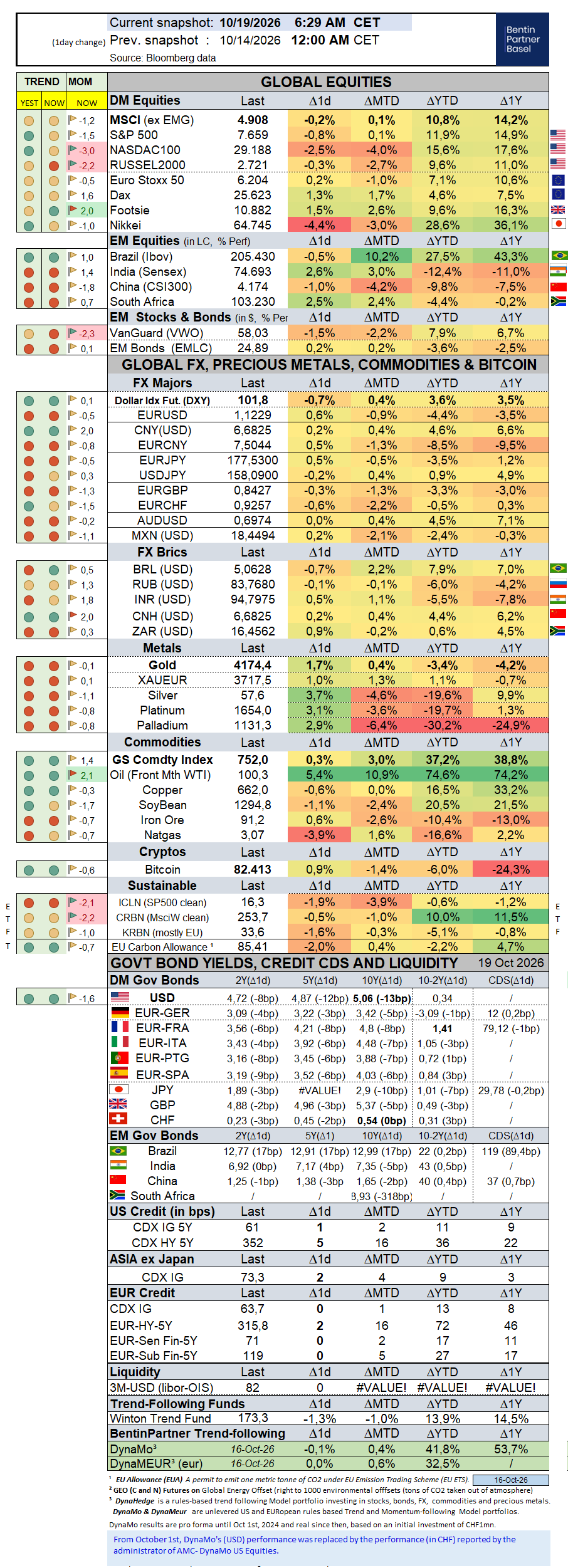
Over the past week, the S&P500 dropped -2,0% (11,9% YTD) while the Nasdaq100 sold off by -5,5% (15,5% YTD, Z-score -3,0). The US small cap index sold off by -3,0% (9,9% YTD, Z-score -2,2). AAPL rallied 2,0% (26,3%).
The Equally Weighed SP500 gained 0,5% (11,8% YTD), outperforming the S&P500 by 2,5%. The median SP500 YTD return closed the week at 6,9%.
Cboe Volatility Index rallied 34,7% (33,7% YTD, Z-score 3,6) to 19,99.
The Eurostoxx50 gained 0,6% (9,4%), outperforming the S&P500 by 2,5%.
Diversified EM equities (VWO) sold off by -2,9% (7,9%, Z-score -2,3), underperforming the S&P500 by-0,9%.
The Dollar DXY Index (UUP) measuring the USD performance vs. other G7 currencies dropped -0,3% (7,0%) while the MSCI EM currency index (measuring the performance of EM currencies vs. the USD) dropped 0,0% (4,2%).
10Y US Treasuries rallied -17bps (91bps) to 5,07%. 10Y Bunds dropped -6bps (57bps) to 3,43%. 10Y Italian BTPs rallied -8bps (94bps) to 4,49%, outperforming Bunds by -2bps.
10Y French OAT’s rallied -5bps (124bps) to 4,81%, underperforming Bunds by 1bps.
US High Yield (HY) Average Spread over Treasuries climbed 23bps (65bps) to 3,31%. US Investment Grade Average OAS climbed 4bps (11bps) to 0,95%.
In European credit markets, EUR 5Y Senior Financial Spread climbed 1bps (17bps) to 0,71%.
Gold dropped -0,7% (-3,6%) while Silver sold off by -6,3% (-20,5%). Major Gold Mines (GDX) dropped -1,8% (2,3%).
Goldman Sachs Commodity Index rallied 2,4% (50,9%, Z-score 2,1). WTI Crude rallied 10,4% (76,6%, Z-score 2,7).
Overnight in Asia…
Ø S&P future +62 points; Hong Kong +0.0%; Nikkei -0.8%; China +0.1%
Ø Futures are doing the easy Sunday overnight bounce after Friday’s deep selloff…the idea being to start the week as if last week never happened.
Ø In contrast, Indonesia stumbled another -5.2% to the lowest since 2020 as MSCI said it was considering downgrading Indonesia from emerging-market to standalone status (whatever that means…), which Bloomberg said could trigger billions of dollars in passive outflows if the country is ultimately removed from major global benchmarks.
Ø Protests which drew more than half a million people on the streets of several French cities on Saturday. Scenes of the Limoges town hall fire prompted a response from US Vice President JD Vance, who linked the events to immigration and a lack of assimilation. “I pray that France, a beautiful country of amazing people, will stop this madness before more of its landmarks burn,” Bloomberg reported. In Milan, where about 5,000 people demonstrated, groups of masked rioters fought police around Piazza del Duomo, the main square at the heart of Italy’s financial capital, throwing paving stones and firecrackers and looting stores as well.
Ø Those protests failed to impact FX markets and the euro in particular, as sentiment towards the dollar shifted last week more towards the negative, following tech stock weakness and in response to higher inflation and lower bond yields.
Ø Russia’s President V. Putin proposed a meeting with President D. Trump and China’s President Xi Jinping next month to discuss ending the war in Ukraine, in a meeting that D. Trump said overnight he sees taking place in absence of V. Zelinski.
Ø Ukraine’s V. Zelenskyy accused D. Trump of trying to pressure Kyiv into surrendering. “Now, we have dangerous days ahead of the elections,” Zelenskyy said, referring to the Nov. 3 midterms in the US. “My latest model was: We don’t target Russian diesel, you give us missiles for Patriot systems to protect our facilities. But they just want us to stop attacking diesel. And if we strike that, they will disconnect us from something.” It seems time is up for real peace negotiations in Ukraine and most likely also a regime change.
Ø China expanded 4.5% (from 4.4% expected), supported by surging exports

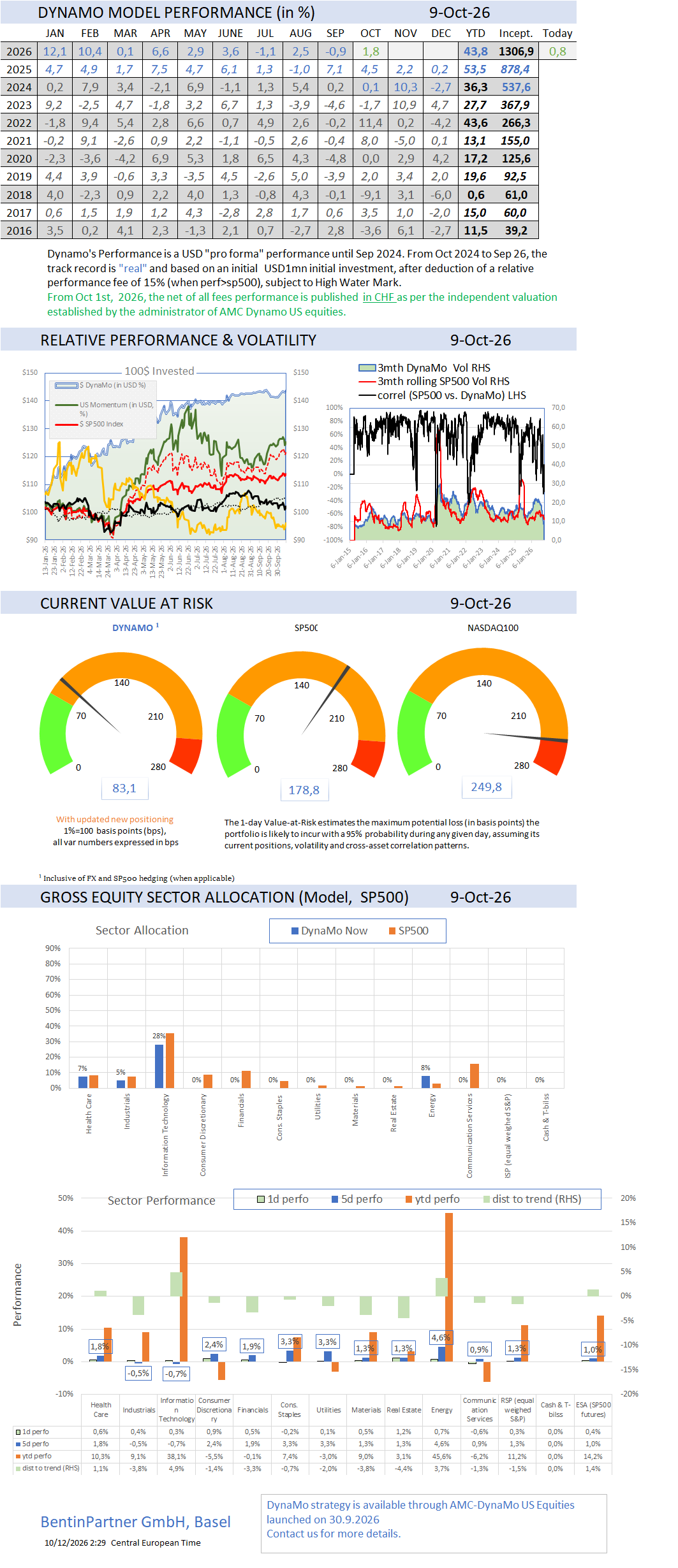
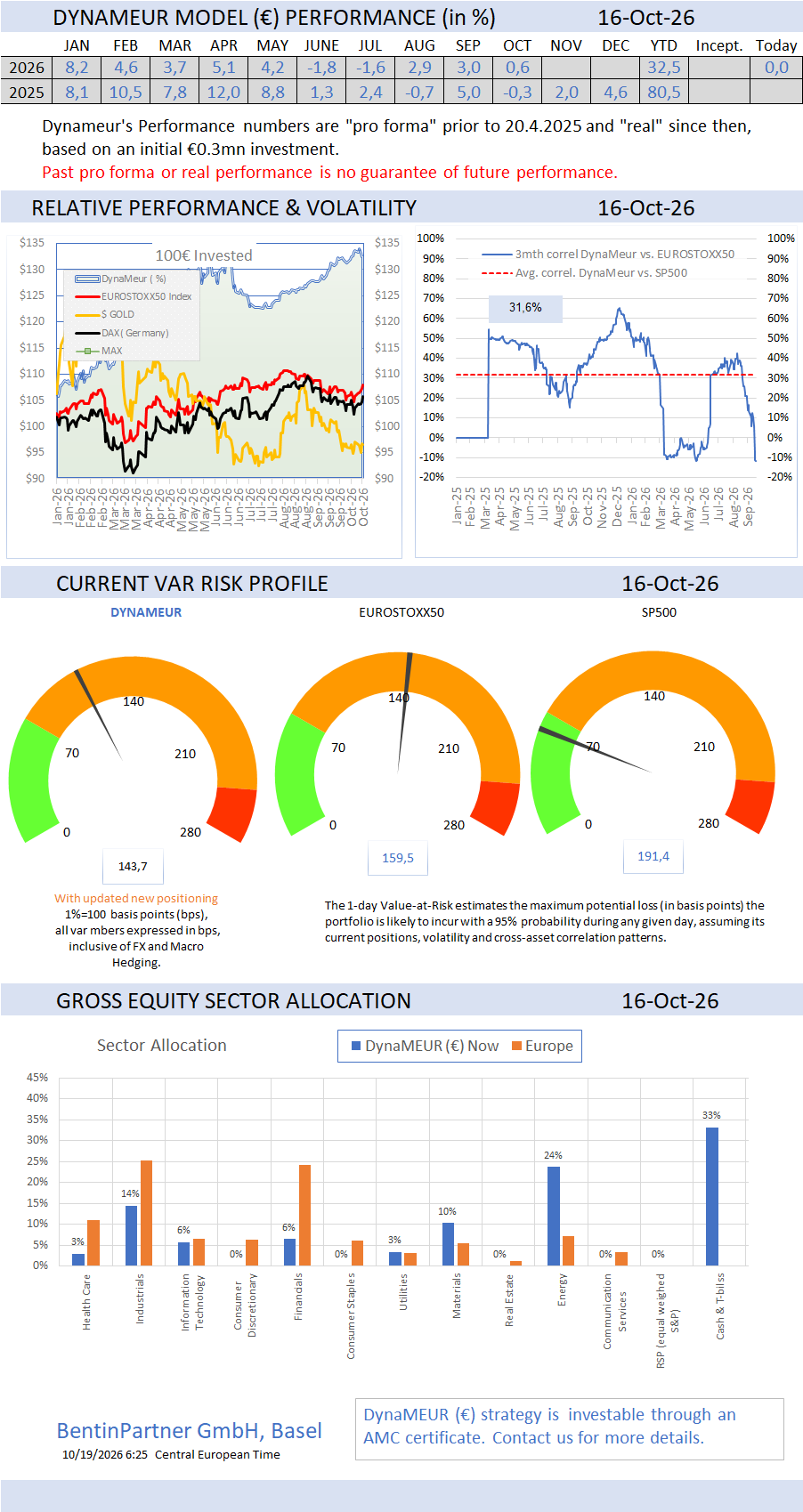
To learn more about our AMC offering and how to invest in the trend-following, visit our Advisory web page.
If you like our Weekly, you will love our Daily!
Consider a subscription today. Discounts may apply!
To learn more about us and how we can assist you, check our website
Important Disclaimer
© Copyright by BentinPartner LLC. This communication is provided for information purposes only and for the recipient's sole use. Please do not forward it without prior authorization. It is not intended as a recommendation, an offer, or solicitation for the purchase or sale of any security or underlying asset referenced herein or investment advice. Investors should seek financial advice regarding the suitability of any investment strategy based on their objectives, financial situation, investment horizon, and particular needs. This report does not include information tailored to any particular investor. It has been prepared without any regard to the specific investment objectives, financial situation, or particular needs of any person who receives this report. Accordingly, the opinions discussed in this report may not be suitable for all investors. You should not consider any of the content in this report as legal, tax, or financial advice. The data and analysis contained herein are provided "as is" and without warranty of any kind. BentinPartner LLC, its employees, or any third party shall not have any liability for any loss sustained by anyone who has relied on the information contained in any publication published by BentinPartner LLC. The content and views expressed in this report represent the opinions of Marc Bentin and should not be construed as a guarantee of performance with respect to any referenced sector. We remind you that past performance is not necessarily indicative of future results. Although BentinPartner LLC believes the information and content included in this report have been obtained from sources considered reliable, no representation or warranty, express or implied, is provided in relation to the accuracy, completeness, or reliability of such information. This Report is also not intended to be a complete statement or summary of the industries, markets, or developments referred to in the Report.

Comments