Not Idiosyncratic? Not Really...

BentinPartner Weekly

Dear Reader,
Please find below our latest Weekly Trend Report.
Have a nice start of the week.
Marc Bentin,
Bentinpartner GmbH
US stocks gained slightly, led by other sectors than AI last week as building tensions in the corporate AI debt market (and in the worst quality segment of the credit market) took some wind off the AI trade while easing tensions on government bonds (whether in the US or Europe), helped other segments of the equity market to get back some colors (such as small caps, utilities and more defensive plays), allowing some diversification away from AI tech.
AI names took a back seat on Thursday following the announcement that OpenAI annualized revenues were about USD50bn or USD20bn less than expected at the end of December. AI sentiment was also dampened as Bloomberg reported that American AI companies performance lead over China had narrowed sharply over the past months and to a record low as labs such as Deepseek gained ground (with top Chinese models only lagging their US rivals by 3% on the benchmark scores, down from 9% in May and 15% earlier this year) as investors need to consider Anthropic mega IPO.
European markets still closed lower for the week, dragged down by weakness in the banking sector which despite being the best sector of the past two years in Europe saw Deutsche Bank trade 18% lower from its August peak (with similar losses seen for other banks disturbed by EU debt tensions.
Elsewhere, despite investors reportedly pulling out USD26.3bn out of EM stocks and bonds in September, Brazil stock exchange rallied to a record high early last week, cheering the victory of Flavio Bolsonaro in the first round of the country’s Presidential elections.
As government bonds improved slightly, Treasury Secretary S. Bessent said “I would be concerned if we were having some kind of idiosyncratic rise”, taking comfort in the fact that yields have been going higher around the world. I am not sure he is right on that statement either to the extent that much (probably as much as half) of the rise in US yields has to do with the stampede and “global crowding out” caused by massive AI debt issuance which might at some point substitute “idiosyncratic” risk with “systemic” risk as the Ai credit bubble approaches its own day of reckoning (not yet visible on AI related equity prices).
The dollar gained 0.4% last week.
US Data published last week showed that the public near term perception of inflation risk jumped in September to 3.9% (from 3.6%), its highest level in over three years (and with heating costs likely to increase by 30% this year) while they also downgraded their current and future financial outlooks.
September Fed minutes published last Wednesday showed that Fed officials overwhelmingly concluded that they had “more work to do “to quell inflation” while US Fed Governor C. Waller said on Thursday that additional rate hikes will likely be needed to lower inflation to the 2% Fed target, although there is “flexibility” about the pace of interest rate hikes and that a pause was possible at the October meeting.
US mortgage rates jumped last week to their highest level in three years, keeping both refinancing (-8% on the week) and home purchases (-2% on the week) on a steady decline. US service sector activity slowed in September with the ISM non-manufacturing dropping to 54.9 (from 55.4 in August) while the job market suggested a slow hire slow fire activity. The US trade deficit widened more than expected in August as imports jumped to a record high on a still solid domestic demand and domestic businesses rebuilding inventories. Also, the US budget deficit reportedly climbed to nearly 2trn in the fiscal year ending on September 30th, according to the CBO, 12% above last year’s level with spending growth exceeding revenues growth by 50% while the CBO Director P. Schwagel warned that embracing faster growth as a solution to reign in the US debt was unlikely to work.
Coupled to a stabilization in the EU debt situation, this data load could earn a pause in the USD rally.
On the EU economic side, German expectations for 2026 GDP figure were also raised to 1.3% (from 0.5% expected in April) with expectations of growth for 2027 around 1.1%. The EU zone Service PMI also climbed to 53 in September (from 51.6 in August), showing some rebound in activity. At the same time, inflation in the EU zone jumped more than expected to 3.8% (from 3.2% in August) on soaring energy costs.
In France mass student riots kept traders on their toes although the situation eased slightly on the bond side (with the OAT/Bund declining slightly). French BoF Governor E. Moulin warned that the country risked being strangled interest rates if it does not act to clean public finances, while adding that “France is not Greece during the EU crisis” and that France can win back investors’ confidence by passing a budget taking concrete steps towards fiscal consolidation.
On the war front, while D. Trump said the US would not attack Iran ahead of the US midterm elections, Iran’s activity intensified in the SoH (and beyond) with several vessels hit last week and over week end and Iran saying it would block routes that it has not authorized. The number of tankers crossing the Soh reached the lowest in two months while Houthis also launched attacks on Saudi Arabia’s capital and tried to reclaim control the BaM waterway.
Attacks on commercial vessels off the Black Sea also intensified last week and Ukraine announced (before this week end Trump intervention) that it will double down on attacking Russian oil refineries. Germany on its part announced another EUR1bn military aid to Ukraine with Chancellor Mertz saying he will not be intimidated into dropping Germany support for Ukraine.
Gold and silver rebounded in the latter part of the week as China returned from holiday with commodities also posting minor gains for the week.
China was seen stepping up its purchases in September, adding 700’000 ounces to its gold reserves as the precious metal approached USD4’000, marking a 23d consecutive month of gold accumulation. A recent speech of Bundesbank President J. Nagel also gave reasons to investors to accumulate more gold, citing mounting credit and geopolitical risks.
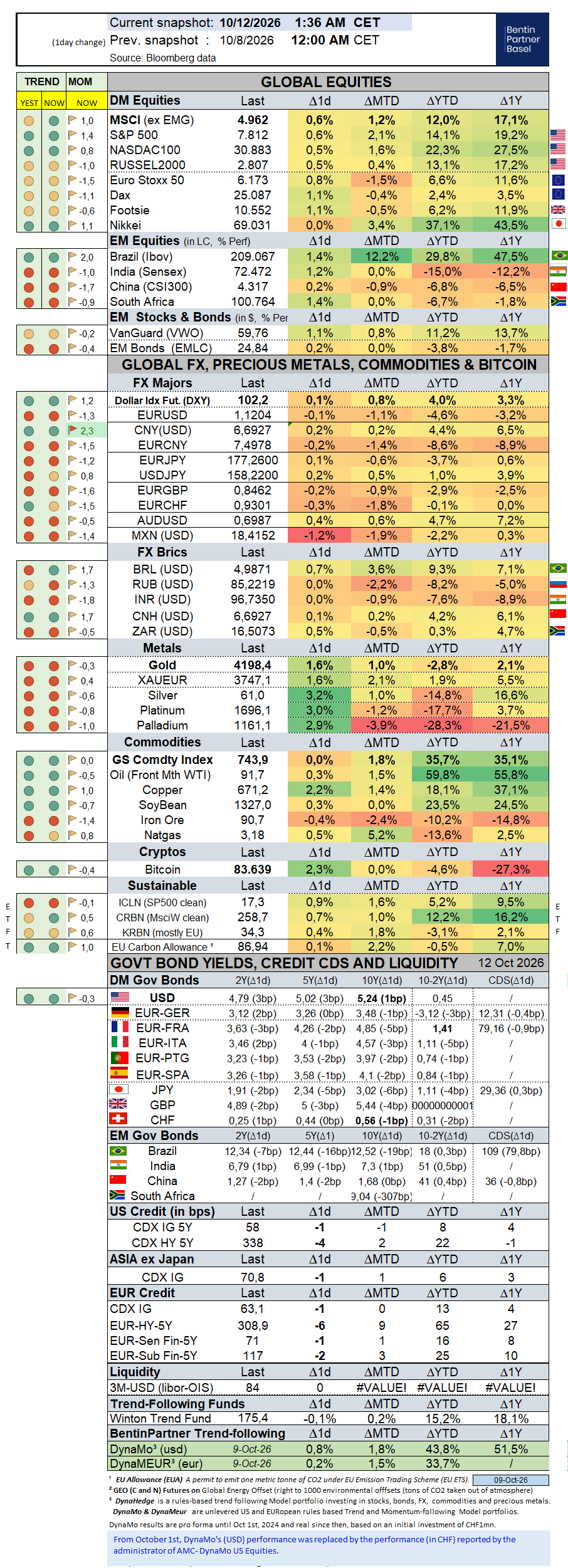
Over the past week, the S&P500 gained 1,2% (14,2% YTD) while the Nasdaq100 gained 0,2% (22,3% YTD). The US small cap index dropped -0,9% (13,3% YTD). AAPL gained 0,9% (23,8%).
The Equally Weighed SP500 gained 1,6% (11,2% YTD), outperforming the S&P500 by 0,4%. The median SP500 YTD return closed the week at 4,6%.
Cboe Volatility Index sold off by -3,1% (-0,7% YTD) to 14,84.
The Eurostoxx50 dropped -1,1% (8,8%), underperforming the S&P500 by-2,3%.
Diversified EM equities (VWO) gained 0,3% (11,2%), underperforming the S&P500 by-0,8%.
The Dollar DXY Index (UUP) measuring the USD performance vs. other G7 currencies gained 0,4% (7,4%) while the MSCI EM currency index (measuring the performance of EM currencies vs. the USD) dropped -0,1% (4,2%).
10Y US Treasuries rallied -7bps (107bps) to 5,24%. 10Y Bunds climbed 2bps (63bps) to 3,48%. 10Y Italian BTPs dropped -3bps (102bps) to 4,57%, outperforming Bunds by -5bps.
10Y French OAT’s rallied -2bps (129bps) to 4,85%, outperforming Bunds by -4bps.
US High Yield (HY) Average Spread over Treasuries climbed 2bps (42bps) to 3,08%. US Investment Grade Average OAS dropped -1bps (7bps) to 0,91%.
In European credit markets, EUR 5Y Senior Financial Spread dropped -1bps (16bps) to 0,71%.
Gold gained 1,2% (-3,1%) while Silver dropped -0,3% (-15,0%). Major Gold Mines (GDX) gained 1,7% (4,1%).
Goldman Sachs Commodity Index gained 1,3% (47,4%). WTI Crude rallied 3,4% (61,1%).
Overnight in Asia…
S&P future +23 points; Hong Kong +0.17%; Nikkei unch.; China -0,1%
As oil stock piles grew dangerously thin, President D. Trump announced that he was lifting sanctions against Russia to allow Russia to supply the US (and global markets) with Diesel as he announced a refinery hitting truce which hopefully will be heard by V. Zelinski who D. Trump was also seen throwing under the bus, saying that Ukraine needed as new leader, capable of accepting peace negotiations. V. Zelinski initially rebuffed this call (as he did in the past) then said he would organize elections pending a 6 weeks truce (going over the mid-terms) …which Russia still remains unlikely to consider. Europe said it would consider more sanctions against Russia instead…
Over the week end, the EU-China reached a deal capping annual imports of hybrid cars to 350’000, staving off a wider EU -China trade war.

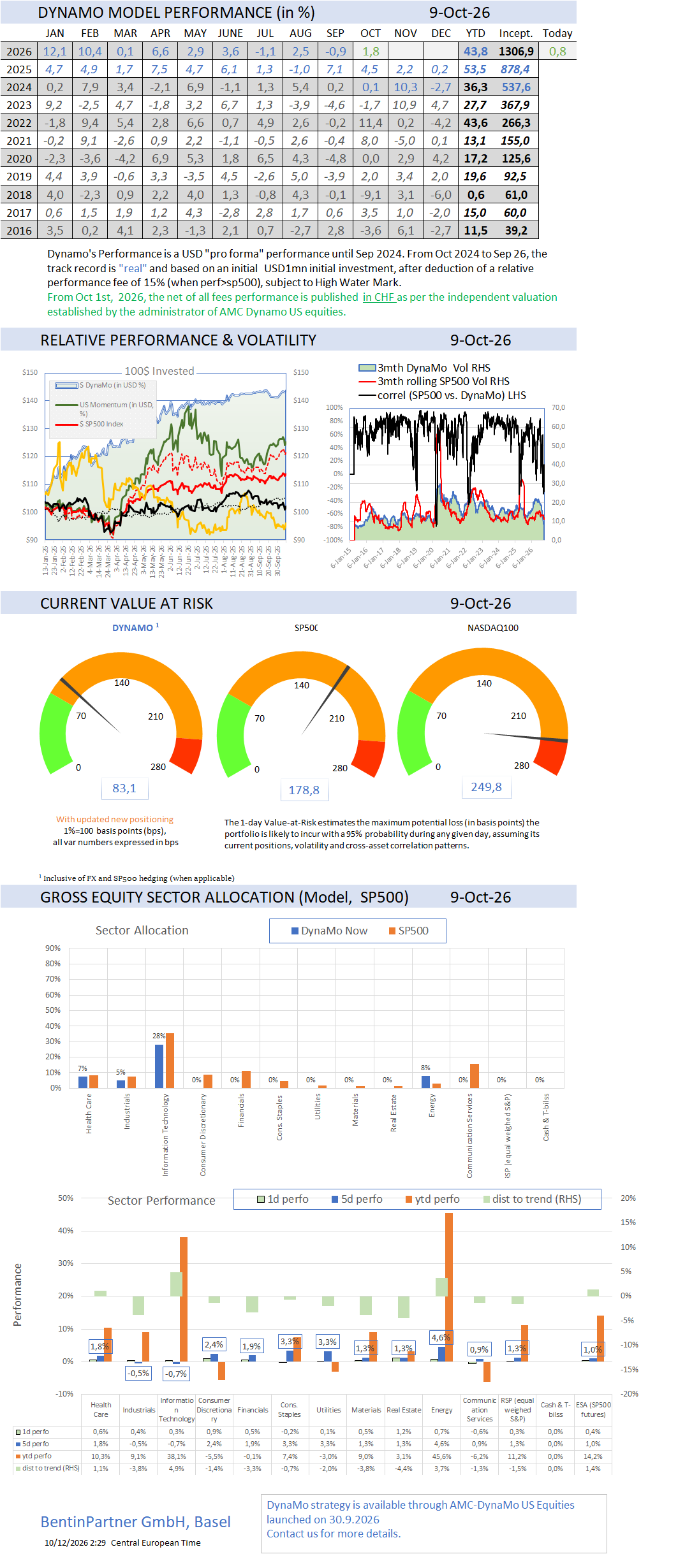
To learn more about our AMC offering and how to invest in the trend-following, visit our Advisory web page.
If you like our Weekly, you will love our Daily!
Consider a subscription today. Discounts may apply!
To learn more about us and how we can assist you, check our website
Important Disclaimer
© Copyright by BentinPartner LLC. This communication is provided for information purposes only and for the recipient's sole use. Please do not forward it without prior authorization. It is not intended as a recommendation, an offer, or solicitation for the purchase or sale of any security or underlying asset referenced herein or investment advice. Investors should seek financial advice regarding the suitability of any investment strategy based on their objectives, financial situation, investment horizon, and particular needs. This report does not include information tailored to any particular investor. It has been prepared without any regard to the specific investment objectives, financial situation, or particular needs of any person who receives this report. Accordingly, the opinions discussed in this report may not be suitable for all investors. You should not consider any of the content in this report as legal, tax, or financial advice. The data and analysis contained herein are provided "as is" and without warranty of any kind. BentinPartner LLC, its employees, or any third party shall not have any liability for any loss sustained by anyone who has relied on the information contained in any publication published by BentinPartner LLC. The content and views expressed in this report represent the opinions of Marc Bentin and should not be construed as a guarantee of performance with respect to any referenced sector. We remind you that past performance is not necessarily indicative of future results. Although BentinPartner LLC believes the information and content included in this report have been obtained from sources considered reliable, no representation or warranty, express or implied, is provided in relation to the accuracy, completeness, or reliability of such information. This Report is also not intended to be a complete statement or summary of the industries, markets, or developments referred to in the Report.
Comments