Early Summer Sales…...

BentinPartner Weekly

Dear Reader,
Please find below our latest Weekly Trend Report.
Have a nice start of the week.
Marc Bentin,
Bentinpartner GmbH
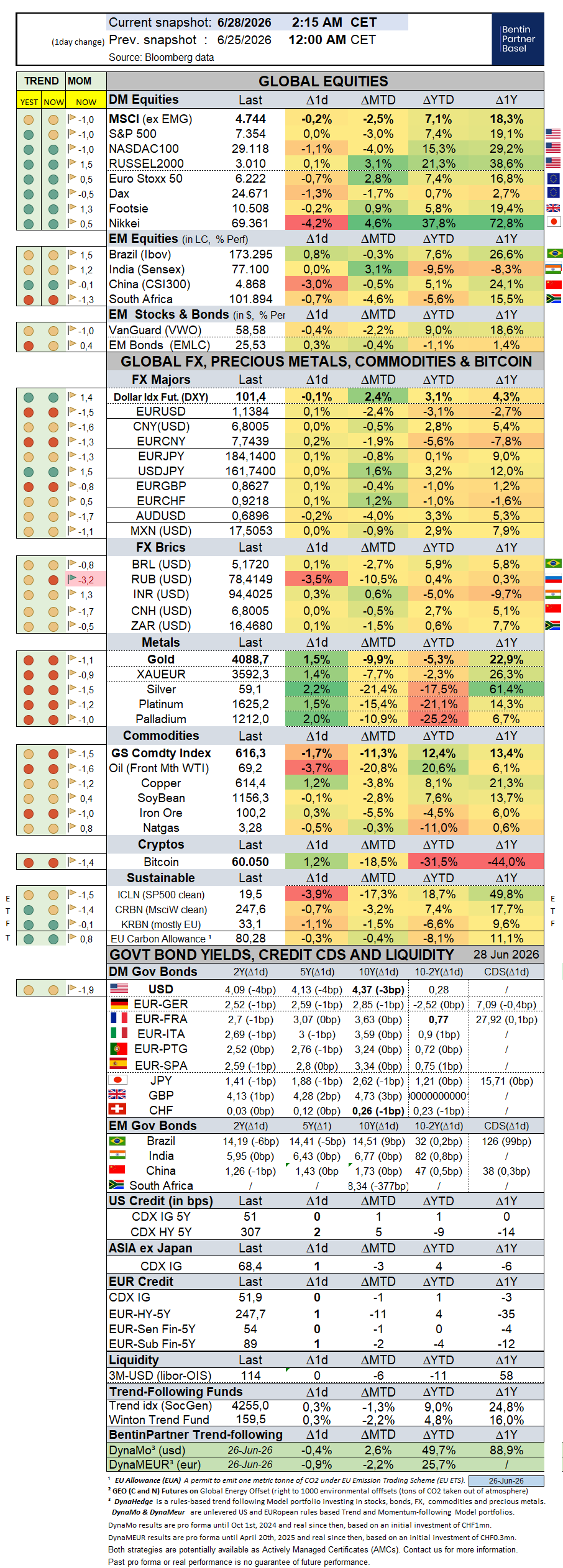
Risk off prevailed for most of the past week with cross asset market instability rising and the Nasdaq driving stocks lower.
Massive leverage in ETF’s and options-related hedging activity led to increase volatility in the AI trade and semiconductors in particular.
Since weeks, whether it's active or passive funds, hedge funds or quantitative strategies, institutions or retail investors, everyone got longer AI, Goldman Sachs wrote, warning that the co-correlation of strategies is a point to watch which can be extremely dangerous during the unwind.
The Semiconductors sank 7.9% (up 86.4%) and South Korea’s KOSPI was particularly volatile sinking 10.0% on Tuesday, recovering on Wednesday and Thursday 2/3d of the decline before sinking again 5.8% on Friday.
US-listed ETFs absorbed about $1trn so far this year, before the end of June, on pace to break last year’s record intake of $1.5trn.
On the other side of the performance ladder last week, Biotech surged 8.1% (up 20.3%).
Even with Friday’s 1.5% rally, the MAG7 Index closed the week with a loss of 5.5%, indirectly allowing breadth to improve as investors flocked to buy S&P493 instead. At Thursday’s intraday lows, MAG7 shed 14% month-to-date.
The Dollar Index traded last week to a one-year high.
Over the past week, the US Treasury market came back to life and the entire US Treasury yield curve dropped by -8bps (ex 30y bonds which dipped only -3bps) and for reasons not entirely clear, perhaps on a safe haven bid.
European government bonds rallied even more strongly with Bunds dropping -13bps, along with most of their EU peers.
In contrast, US HY (High yield) spreads widened by 17 bps, following stocks lower and as investor redemption requests from private credit funds pointed at continuing stress in this asset class. Late last week, Ares Management curbed withdrawals from one of its private credit funds for the second consecutive quarter after redemption requests rose to 14.4% in Q2 (from 11.6% in Q1), saying to would allow investors to take out only 5% of their shares.
Selling USD75bn stocks at the top was not enough and SpaceX also sold USD25bn bonds… but “SpaceX’s blockbuster bond sale has been weakening so quickly in the secondary market that traders said they could not recall another recent deal that widened this sharply. One large dealer was quoting SpaceX bonds maturing in 2056 (a clean 30 years) on Friday at levels as much as 32bps wider than the issue price of 1.75 percentage points above Treasuries.
Also in credit, it was released that Fannie Mae and Freddie Mac are taking on more interest-rate risk in their rapidly growing investment portfolios, driving a key gauge of their exposure to levels that rattled Wall Street two decades ago, analysts opined. Their duration gaps widened significantly in recent months, after the government-backed companies added more than $135bn to their retained portfolios over the past year, following President. Trump's push to ease housing costs by shrinking the supply of mortgage-backed securities available to investors.
Elsewhere, JGB’s bond strategists warned that Prime Minister Sanae Takaichi’s $2.3 trillion investment plan announced last Wednesday risks putting fresh pressure on Japan’s government debt market and JGB’s underperformed the global bond rally last week (although they improved slightly as well).
With Gold dropping 5.3%, Gold shares slumped 6.7%. Silver was also slammed 8.9%, trading below $60 for the first time since December (down 17.5% y-t-d).
Bitcoin shed -5.3% below 60k, (down 31.7% ytd) with fears mounting that Michael Saylor’s (Microstrategy, MSTR) is beginning to seize up, spilling across the crypto market… The company repeatedly issued “preferred” securities (with a guaranteed coupon, to fund additional bitcoins purchases) and investors are now increasingly questioning whether that machine can keep running after a prolonged Bitcoin decline.
With an estimated 11 months of cash left to pay the preferred shares dividends, M. Saylor has been using his cash flows to buy more bitcoins on the way down rather than setting his priority to restore his dollar cash buffer, Julio Moreno, head of research at CryptoQuant warned.
Oil was no place to hide last week with WTI crude getting hammered by 10.7%, the low since early March. Outside the energy complex, commodities also dropped including Aluminum (-6.4%), Nickel (-5.0%), Cotton (-5.7%), and Wheat (-4.5%).
On the economy side…
The US economy expanded at a solid 2.1% (revised up from 1.6%) annual pace in its final estimate of Q1 growth, marking a solid rebound from a sluggish 0.5% in Q4 2025.
Excluding housing, private investment jumped 10.6%, up from 2.4% in Q4 2025. Investment in IT equipment jumped at a 39.9% pace as companies outfit their data centers.
On inflation, the preferred Fed inflation gauge, the core PCE index QoQ rose 4.4%, well above the 2% Fed target.
While oil dropped markedly over the past week (without a similar impact at the pump to the chagrin of D. Trump last week), Apple raised iPad and MacBook prices…, saying it could no longer shield customers from soaring memory and storage chip costs. ‘We have shielded our customers from these increases so far, but we have now reached a point where we need to begin raising prices on a number of products, including today's increases for iPad and Mac.’, ‘We have never seen a component price increase this much, this quickly,’ Apple said...the company said.
Microsoft also substantially increased the price of its Xbox.
Elsewhere in Europe, the heat wave that is impacting much of Europe is officially the most severe ever recorded in the region. Researchers at World Weather Attribution, who looked at heat and humidity levels during both the day and night during three consecutive days in the month of June, found that temperatures were between 5C and 12C above the seasonal averages across France, Germany, Italy, Spain and southern England.
BoE officials are reportedly beginning to fret that, as one supply shock dissipates, the weather could produce the next one to push up inflation. Climate scientists increasingly expect a severe El Niño event disrupting global weather patterns will take hold later this year and into 2027 with economists now beginning to worry that it could cause the next supply shock that boosts food inflation and provide the latest setback for central banks.
In China, the country reported that it reduced its cumulative fiscal deficit for the first time in more than two years by 4.1% in the first five months from the same period a year earlier. Last month alone, government expenditure fell 3.9% on year, the third consecutive month of decline.
China has also been choking shipments of some critical minerals to Japan, a slowdown that’s hurting companies and prompting calls for Prime Minister Sanae Takaichi to find a diplomatic off-ramp with Beijing. The throttling of goods began after Takaichi angered Beijing last November with comments about self-ruled Taiwan.
On Geopolitics…
U.S. President Donald Trump said on Tuesday that Iran had agreed to nuclear inspections into ‘infinity,’ while Tehran said it had made no such concession.
Oman told EU officials there’s no way of going back to the pre-war status quo with the SoH and transiting ships may have to be charged some fees related to “de-polluting the strait or helping ships navigate it…”
Earlier on the same issue, President D. Trump said tolls on ships sailing in the SoH would be a red line issue for the US in negotiations with Iran. Asked if he would reject a final Iran deal if it included any service or shipping fees in the strait, Trump said that he would. ‘It would be unacceptable to me, because we have numerous strengths, and if you did that for them, you’d have to do it for other people,’ the president objected… ‘It would be a game changer.’”
For what it is worth, Egypt does charge a toll for every vessel transiting the Suez Canal. These tolls are a major source of revenue for the Egyptian state.
And Egypt did fight wars that ultimately strengthened its sovereignty over the canal and removed foreign English and French interference.
It is being argued that the SoH is a straight and the Suez-canal a man-made construction but a state that has been attacked in a way that it considers illegal (without UN agreement) may not feel bound by fine legal distinctions that the attackers themselves ignored…
As Russia continued to establish its dominance on the ground, Ukraine has been pounding Russian oil refineries with long-range drone strikes, leading to restrictions on fuel sales, surging gasoline prices and huge lines of cars outside gas stations hundreds of miles from the front lines.
The EU strategy remains to encourage Ukraine to “poke the bear”, and to use explosions at Russian refineries near Moscow as evidence of “military success” (and even of the tide turning militarily) with no fear of retribution from Russia. This strategy will ultimately force Russia to re-establish “deterrence” and could severely backfire against Europe. Following a pro-war agenda that can only lead at some point to a (much more) direct confrontation with Russia, will hurt the three musketeers (one is already down) as there is only scant to no popular support at all for such an agenda in Europe. That said, President E. Macron has not yet fixed the date of the next presidential election either… and he is actively pursuing a “pro-democracy” policy actively aimed under the pretext of “banning foreign interference” to directly silence the expression of political dissent in the French political landscape (with only thinly veiled pressure exerted on CNews).
Over the past week, the S&P500 shed -2,4% (6,9% YTD) while the Nasdaq100 sold off by -4,6% (15,0% YTD). The US small cap index in contrast gained 1,4% (21,8% YTD). AAPL sold off by -4,8% (4,4%).
The Equally Weighed SP500 gained 0,2% (9,8% YTD), outperforming the S&P500 by 2,5%, allowing breadth to improve (as investors bought the SP493). The median SP500 YTD return closed the week at 8,2%.
Cboe Volatility Index rallied 12,3% (23,1% YTD) to 18,41.
The Eurostoxx50 dropped -1,2% (9,3%), outperforming the S&P500 by 1,2%.
Diversified EM equities (VWO) sold off by -3,6% (9,0%), underperforming the S&P500 b y-1,2%.
The Dollar DXY Index (UUP) measuring the USD performance vs. other G7 currencies gained 0,6% (5,3%) while the MSCI EM currency index (measuring the performance of EM currencies vs. the USD) dropped -0,5% (0,2%).
10Y US Treasuries rallied -8bps (20bps, Z-score -2,1) to 4,37%. 10Y Bunds dropped -13bps (0bps) to 2,85%. 10Y Italian BTPs rallied -11bps (4bps) to 3,59%, underperforming Bunds by 2bps.
10Y French OAT’s rallied -11bps (7bps) to 3,64%, underperforming Bunds by 2bps.
US High Yield (HY) Average Spread over Treasuries climbed 17bps (16bps, Z-score 2,2) to 2,82%. US Investment Grade Average OAS climbed 4bps (0bps, Z-score 3,0) to 0,84%.
In European credit markets, EUR 5Y Senior Financial Spread climbed 0bps (0bps) to 0,54%.
Gold dropped -1,6% (-5,3%) while Silver sold off by -8,9% (-17,5%). Major Gold Mines (GDX) sold off by -6,7% (-10,2%).
Goldman Sachs Commodity Index sold off by -3,8% (18,8%). WTI Crude sold off by -9,6% (20,6%).
Overnight in Asia…
S&P future +42 points (after gapping down as much seconds before the close on Friday); Hong Kong +1.4%; Nikkei -0.7%; China -0.5%
US futures rallied after the US and Iran following a week end of fierce battling made peace again this morning…
President Trump on Friday called Iran’s attack on a container ship transiting the Strait of Hormuz a day earlier a ‘foolish’ act and a few minutes after the US stock market close, the US military launched strikes on Iran. Iran claimed that in response to these American attacks on Friday, Tehran had struck US Army positions in the region. A few hours before US futures opened on Sunday, as was to be expected, TACO36 emerged and all seemed fine to continue negotiations…
The question is less whether oil goes up or down from here after what looks like a US strategic defeat but whether the AI bubble has sufficient breathing room to keep animal spirits alive going into the Summer break. Most likely yes. But there is a higher probability for more rotation towards value and out of tech, in my view, as all signs of unsustainable speculative excesses (and unavoidable ultimate unwind) are fairly obvious to see. Bounces will likely be used for that purpose.

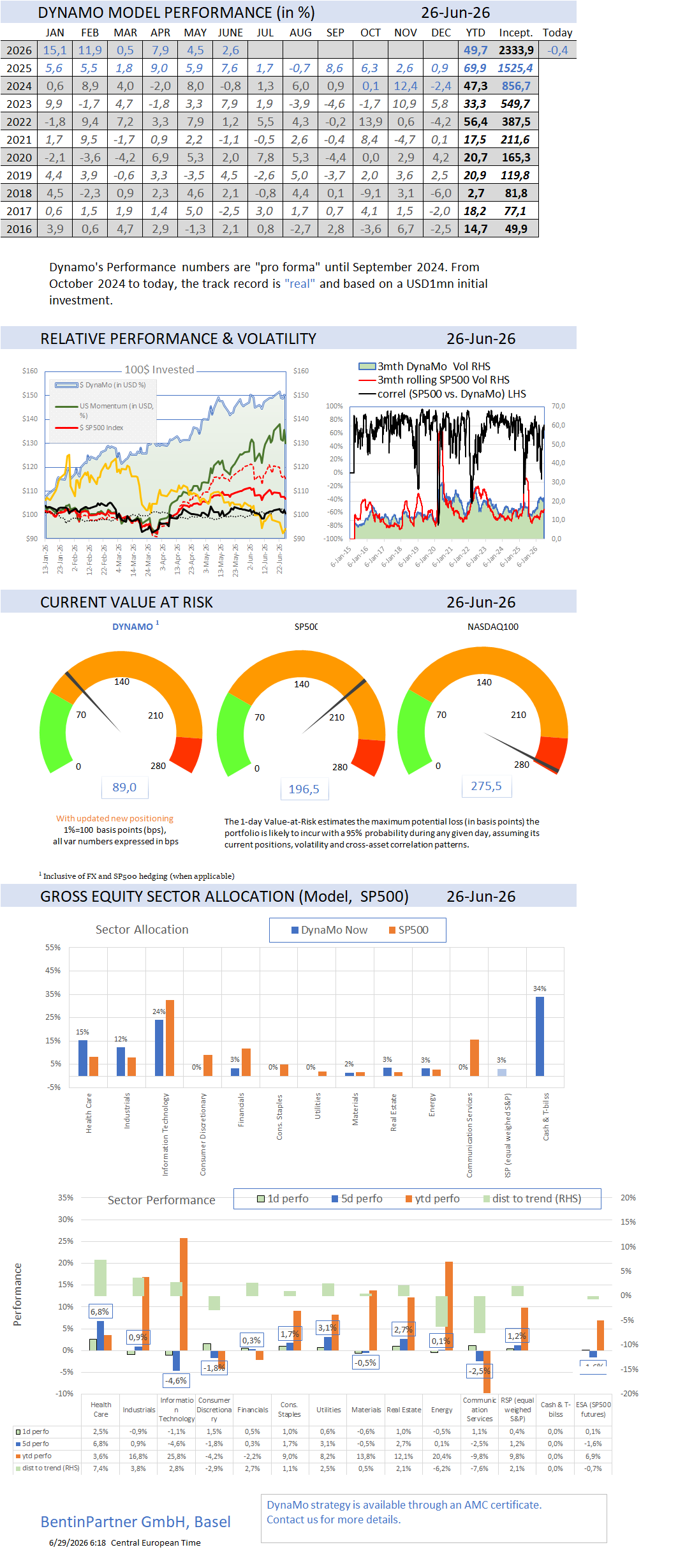
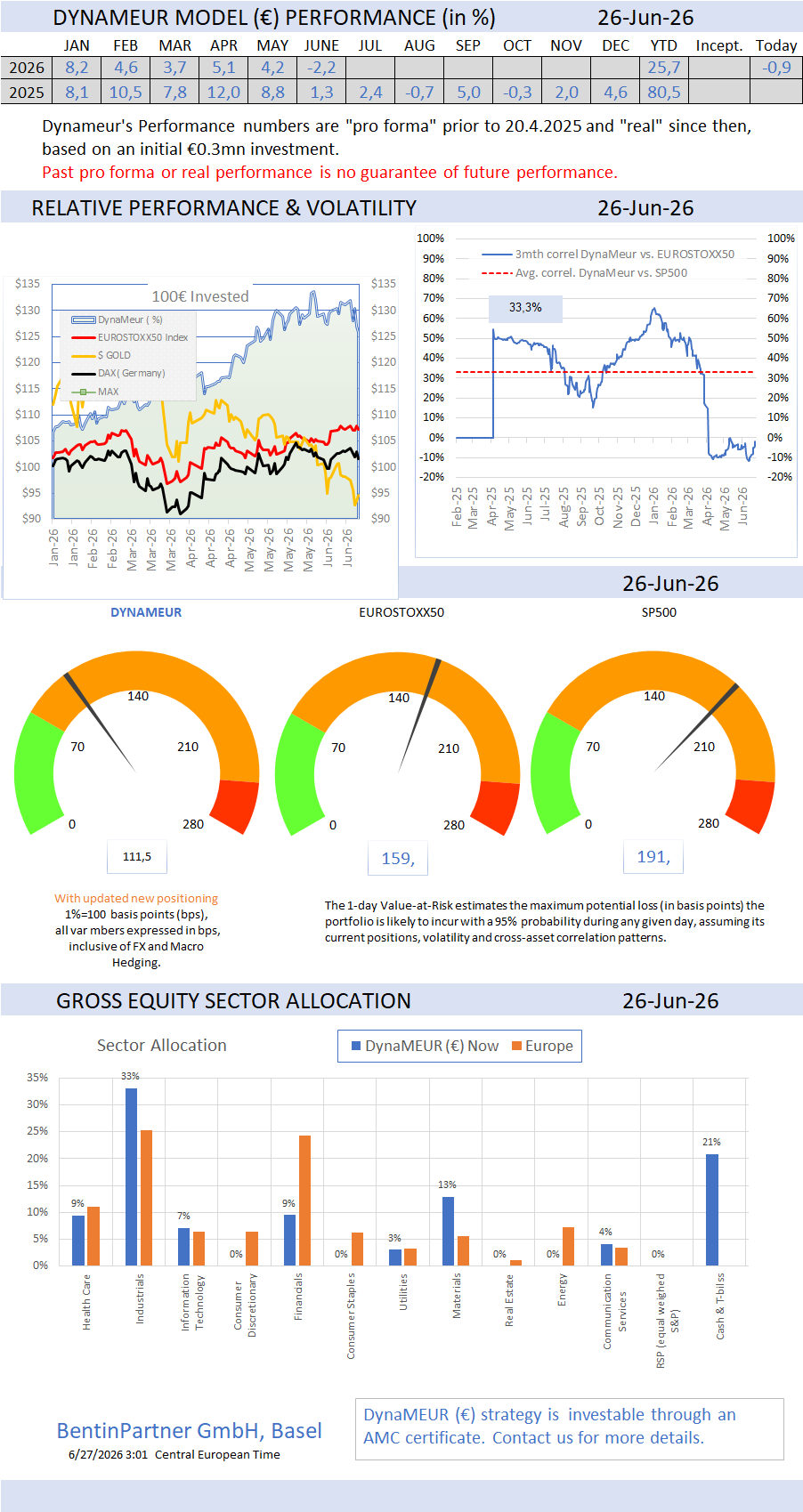
To learn more about our AMC offering and how to invest in the trend-following, visit our Advisory web page.
If you like our Weekly, you will love our Daily!
Consider a subscription today. Discounts may apply!
To learn more about us and how we can assist you, check our website
Important Disclaimer
© Copyright by BentinPartner LLC. This communication is provided for information purposes only and for the recipient's sole use. Please do not forward it without prior authorization. It is not intended as a recommendation, an offer, or solicitation for the purchase or sale of any security or underlying asset referenced herein or investment advice. Investors should seek financial advice regarding the suitability of any investment strategy based on their objectives, financial situation, investment horizon, and particular needs. This report does not include information tailored to any particular investor. It has been prepared without any regard to the specific investment objectives, financial situation, or particular needs of any person who receives this report. Accordingly, the opinions discussed in this report may not be suitable for all investors. You should not consider any of the content in this report as legal, tax, or financial advice. The data and analysis contained herein are provided "as is" and without warranty of any kind. BentinPartner LLC, its employees, or any third party shall not have any liability for any loss sustained by anyone who has relied on the information contained in any publication published by BentinPartner LLC. The content and views expressed in this report represent the opinions of Marc Bentin and should not be construed as a guarantee of performance with respect to any referenced sector. We remind you that past performance is not necessarily indicative of future results. Although BentinPartner LLC believes the information and content included in this report have been obtained from sources considered reliable, no representation or warranty, express or implied, is provided in relation to the accuracy, completeness, or reliability of such information. This Report is also not intended to be a complete statement or summary of the industries, markets, or developments referred to in the Report.

Comments