Approaching a "Whatever It Takes..."

BentinPartner Weekly

Dear Reader,
Please find below our latest Weekly Trend Report.
Have a nice start of the week.
Marc Bentin,
Bentinpartner GmbH
The recent tech selloff was quickly erased and forgotten about as investors’ enthusiasm returned last week, enabling US stocks to close at a fresh record high, despite credit markets remaining more circumspect with free cash flow estimates still heading lower in the face of massive capex spending from Ai hyperscalers which tapped the debt markets aggressively again last week. Equities also gained on hopes for a SoH revival as Reuters reported that a US official was expecting a deal soon between Iran and Oman.
Last Friday’s disappointing Non-Farm payrolls report (-23k vs. +80k job creation expected) was taken in stride and even with some enthusiasm as it pushed back some of the remaining (and ill placed in my view) Fed rate hike expectations.
There are other reasons why the Fed wait and see attitude may actually not translate into higher rates any time soon as there are talks that the so called preferred “core PCE” inflation indicator may at some point fall out of grace (it has been fairly sticky and actually heading stronger than headline inflation) at the conclusion of one of the many working groups set in place by recently appointed Fed Chairman, K. Warsh.
Another particularity of Friday’s jobs report was the big drop (of 1mn workers) in the labor force participation which enabled the unemployment rate to remain stable. Perhaps more and more workers are also choosing to quit their job or stopped looking for one, to day trade this bullet proof and “too big to fail” equity market because so much of the economy has now become dependent on the wealth effect (with household holdings having increased USD7trn so far this year, following a USD9trn gain in both 2025 and 2024 according to BoA). In terms of flows, last week, investors piled up USD32.9bn more into equity markets.
Other economic data showed last week that manufacturing activity expanded in the July at the fastest pace in more than four years (ISM manufacturing surged to 55.6) while ISM services also increased to 54.1 with the job component relatively strong (contrasting with the NFP report) and jobless claims remaining at an historical low of 200k.
The major event in FX besides the price action itself which was fairly subdued was the decision by the United States to sell EUR against JPY without telling the ECB until after the trade was done. ECB officials called it an “unprecedented breach of longstanding conventions” that has never happened before. Perhaps, the US which has committed to support Japan in its efforts to prop up the yen (after the currency dropped to its lowest level since 1986 despite solo intervention by the MoF) did not want to be seen as contradicting its strong dollar policy by selling dollars. And the reason why the Fed intervened at all was to lend whatever support it could to Japan in order to enable the country, which is the largest foreign holder of US Treasuries, not to sell too much of its stock of Treasuries which would (and probably did already to an extent) exert upwards pressure on US yields.
This intervention also helped prevent tighter financial conditions from cutting short the boom‑and‑bubble cycle. Some analysts argue that the way the U.S. is now enabling Japan to intervene, specifically through the Foreign and International Monetary Authorities (FIMA) Repo Facility, which historically was used rarely and only for very short periods, effectively means that, despite the Fed’s rhetoric about further rate hikes and continued balance‑sheet reduction, it has likely begun expanding its balance sheet again. It’s premature to call this QE, but it would be surprising to see Japan repay this dollar borrowing against Treasuries in the coming days. And if Treasury Secretary S. Bessent has just requested an increase in the facility’s size, that suggests the BoJ intends to use it more frequently and for longer.
If I wanted to be blunt, I would call this money printing by the Fed to allow Japan to sell dollars into the market without selling Treasuries. More realistically, I see it as a sign that the intervention requires additional firepower, and will likely receive it. In my view, this raises the risk of a weaker dollar going forward. I have been relatively bullish on the dollar for most of this year, but I am now moving away from that stance.
US 10Y yields dropped -9 bps last week at 4.6% while 10Y Bund yields dropped -12 bps as bond yields fell on speculation the Federal Reserve won’t be forced to raise interest rates any time soon. Short-dated Treasuries outperformed. Money markets still project a Fed hike this year, but not before December.
Despite last week’s improvement, I do not expect bond yields to stabilize until the Federal Reserve implements some form of yield‑curve anchoring. Inflation is not declining anytime soon, federal borrowing needs continue to rise while foreign buyers hesitate, and hyperscalers show no sign of slowing their borrowing spree. They are crowding out the bond market as aggressively as possible.
Meanwhile, although Kevin Warsh’s admiration for Alan Greenspan is well known, it was striking to hear Treasury Secretary S. Bessent invoke Mario Draghi’s “whatever it takes” rhetoric last week when discussing U.S. efforts to stabilize the yen. The goal seems to be managing perceptions and defusing the recent risks of market dislocation and instability, even as markets sit at all‑time highs. In such an environment, and with midterm elections approaching, it is hard to imagine the Fed tightening further. After all, what would Donald Trump have to showcase if not stock markets at record levels?
It is possibly no coincidence that precious metals chose these developments to bottom out last week (after several failed attempts), although it was only a question of time with Central Banks buying of Gold accelerating, reinforcing the bullish case for Gold and precious metals in general.
I also returned to my beginning of year allocation to precious metals.
Elsewhere, Spain and Italy’s feud over migration escalated last week after Rome bluntly refused to lift new border controls imposed after.
Numerous EU leaders criticized Spanish Prime Minister Pedro Sánchez after the incident of the sudden influx of 70,000 migrants to a Spanish African exclave, with some even threatening to suspend Spain’s participation in Schengen.
Spain is showing the open wound of unchecked immigration being instrumentalized for political reasons. That may be the Spanish way of doing it while France is doing it by letting an extreme left political LFI movement capitalize on the forces of immigration to contain a landslide from the so called “extreme” right, including by trying to cut the wings of free speech, threatening the take down entire social networks (see war of words between the French government and E. Musk), tv channels (let’s see what will happen to CNews after the summer), sanction individuals without judgment for simply being in disagreement with what increasingly appears as an unsustainable official narrative, whether it pertains to the war in Ukraine or more simply the economic situation of the country.
Over the past week, the S&P500 rallied 3,5% (13,4% YTD) while the Nasdaq100 rallied 5,1% (17,7% YTD). The US small cap index rallied 3,6% (22,5% YTD, Z-score 2,0). AAPL gained 1,4% (15,3%).
The Equally Weighed SP500 rallied 2,4% (14,9% YTD), underperforming the S&P500 by-1,1%. The median SP500 YTD return closed the week at 10,5%.
Cboe Volatility Index sold off by -6,8% (-0,3% YTD) to 14,9.
The Eurostoxx50 rallied 2,7% (14,9%, Z-score 2,0), underperforming the S&P500 by-0,8%.
Diversified EM equities (VWO) rallied 2,9% (12,5%), outperforming the S&P500 by -0,6%.
The Dollar DXY Index (UUP) measuring the USD performance vs. other G7 currencies dropped -0,4% (3,8%) while the MSCI EM currency index (measuring the performance of EM currencies vs. the USD) gained 0,3% (2,5%).
10Y US Treasuries rallied -9bps (48bps) to 4,65%. 10Y Bunds dropped -7bps (28bps) to 3,13%. 10Y Italian BTPs rallied -12bps (35bps) to 3,90%, outperforming Bunds by -5bps.
10Y French OAT's rallied -8bps (35bps) to 3,92%, outperforming Bunds by -1bps.
US High Yield (HY) Average Spread over Treasuries dropped -15bps (-2bps) to 2,64%. US Investment Grade Average OAS dropped -2bps (2bps) to 0,86%.
In European credit markets, EUR 5Y Senior Financial Spread dropped -2bps (-1bps) to 0,54%.
Gold rallied 7,3% (0,5%, Z-score 2,9) while Silver rallied 10,4% (-11,3%, Z-score 2,6). Major Gold Mines (GDX) rallied 21,3% (4,8%, Z-score 3,0).
Goldman Sachs Commodity Index dropped -1,8% (29,3%). WTI Crude sold off by -7,7% (36,2%).
Overnight in Asia…
S&P future +7points; Hong Kong +0.7%; Nikkei +1.7%; China -0.5%
Asian shares tracked Wall Street higher after soft US jobs data eased expectations for a Federal Reserve interest-rate hike. Oil extended gains as Iran rejected talks with the US and a deal to reopen the Strait of Hormuz remained elusive, Bloomberg wrote.


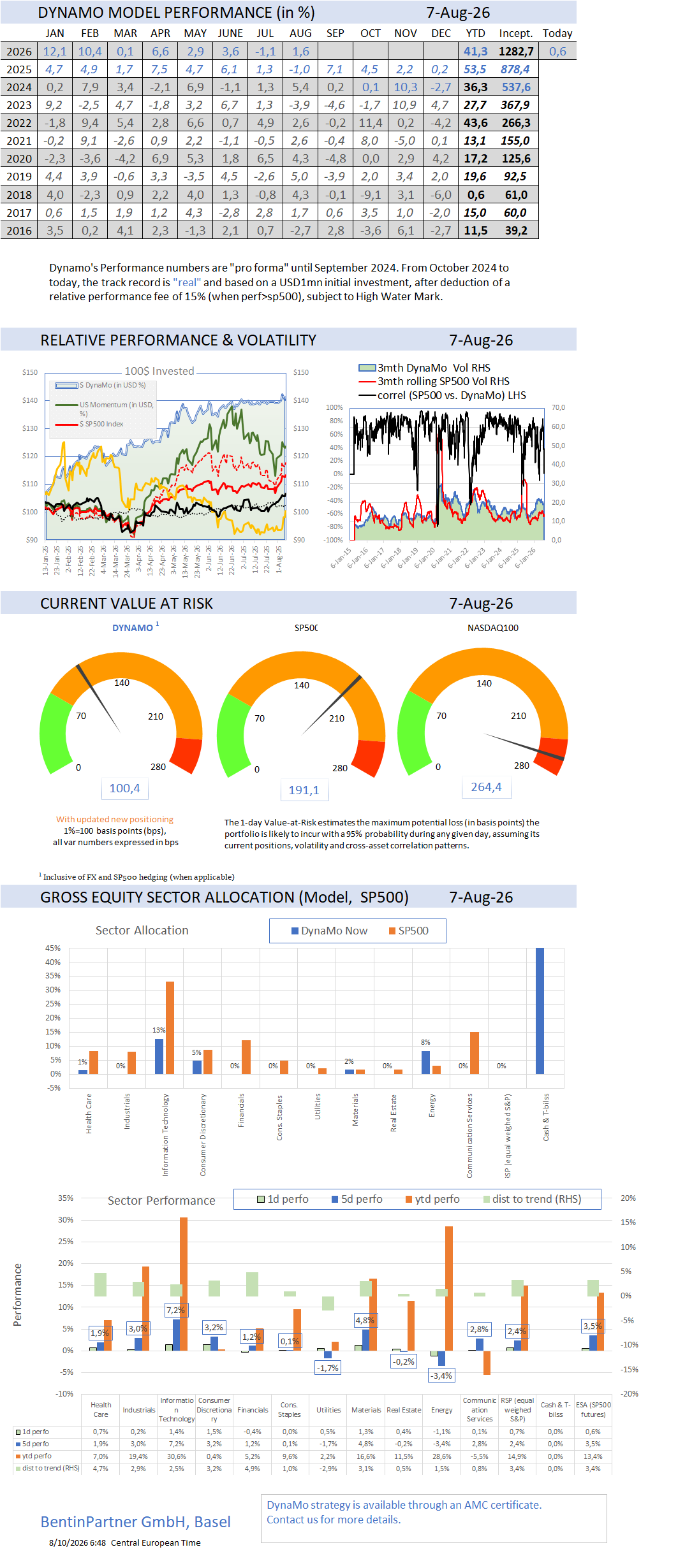
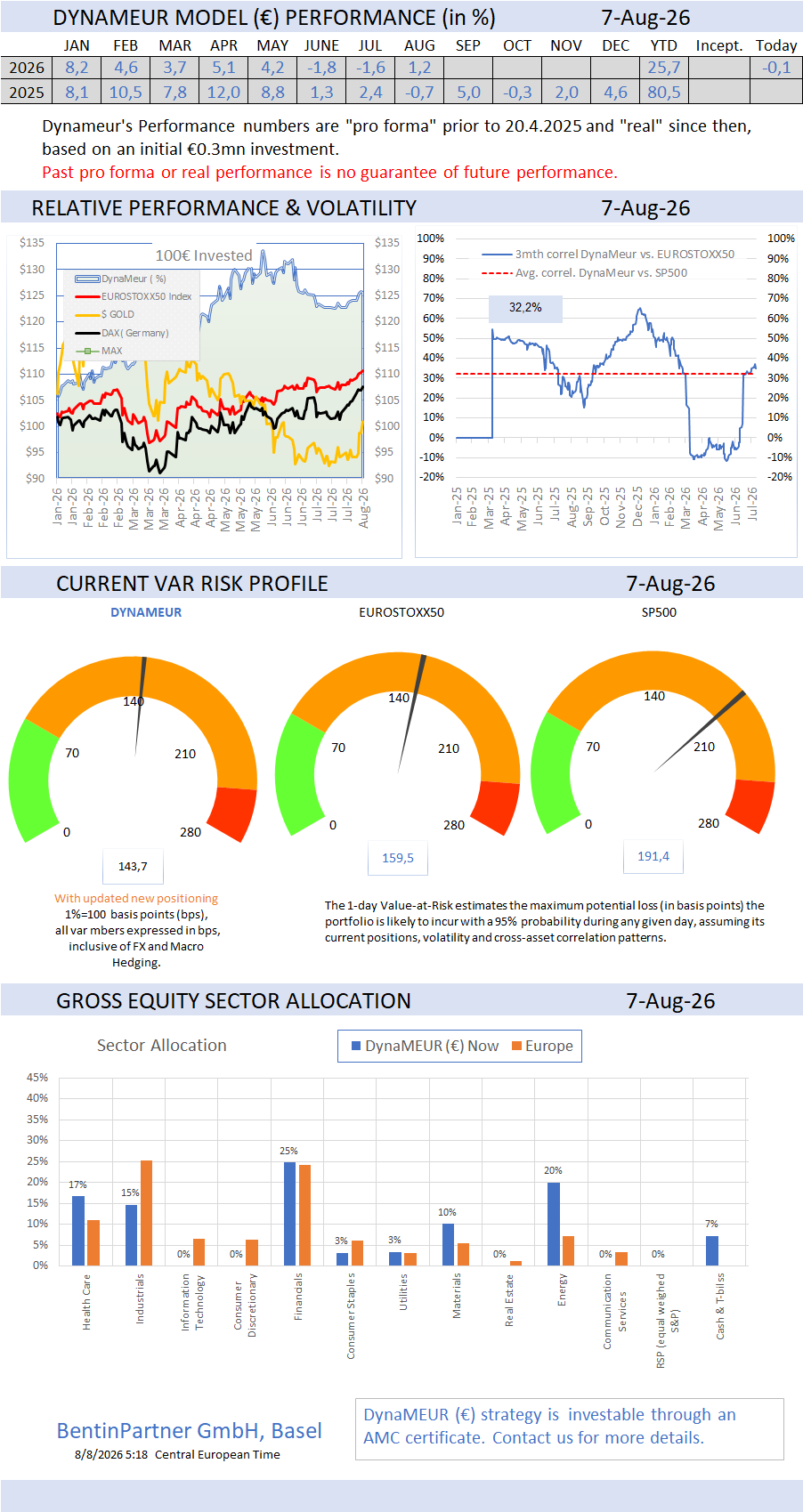
To learn more about our AMC offering and how to invest in the trend-following, visit our Advisory web page.
If you like our Weekly, you will love our Daily!
Consider a subscription today. Discounts may apply!
To learn more about us and how we can assist you, check our website
Important Disclaimer
© Copyright by BentinPartner LLC. This communication is provided for information purposes only and for the recipient's sole use. Please do not forward it without prior authorization. It is not intended as a recommendation, an offer, or solicitation for the purchase or sale of any security or underlying asset referenced herein or investment advice. Investors should seek financial advice regarding the suitability of any investment strategy based on their objectives, financial situation, investment horizon, and particular needs. This report does not include information tailored to any particular investor. It has been prepared without any regard to the specific investment objectives, financial situation, or particular needs of any person who receives this report. Accordingly, the opinions discussed in this report may not be suitable for all investors. You should not consider any of the content in this report as legal, tax, or financial advice. The data and analysis contained herein are provided "as is" and without warranty of any kind. BentinPartner LLC, its employees, or any third party shall not have any liability for any loss sustained by anyone who has relied on the information contained in any publication published by BentinPartner LLC. The content and views expressed in this report represent the opinions of Marc Bentin and should not be construed as a guarantee of performance with respect to any referenced sector. We remind you that past performance is not necessarily indicative of future results. Although BentinPartner LLC believes the information and content included in this report have been obtained from sources considered reliable, no representation or warranty, express or implied, is provided in relation to the accuracy, completeness, or reliability of such information. This Report is also not intended to be a complete statement or summary of the industries, markets, or developments referred to in the Report.
Comments