Kevin Warsh Delivers a Hawkish Message

BentinPartner Weekly

Dear Reader,
Please find below our latest Weekly Trend Report.
Have a nice start of the week.
Marc Bentin,
Bentinpartner GmbH
As expected, Fed Chair Kevin Warsh delivered a distinctly hawkish message at Jackson Hole, signaling that the Fed will raise interest rates if inflation does not fall soon.
“The Fed’s 2% objective, measured by the PCE price index, is a firm and fixed target. Price stability is not self‑executing, nor is inflation necessarily mean‑reverting. It is the Fed’s job to deliver stable prices,” Warsh said.
He added that “short‑term interest rates are the predominant tool to achieve the dual mandate. Unconventional policies to spur economic activity may suit genuine crises, but should otherwise be used sparingly, if at all.”
The initial market reaction was exactly what the Fed would have hoped for: the long end of the curve rallied, dropping 4 bps in a classic flattening move (2‑year yields climbed 8 bps to 4.31%), and equities responded positively, with the S&P 500 up 0.5%.
However, things soured as the trading session progressed with all gains in the long end petering out and with the stock market also reversing course to close 0.25% lower. The only positive thing from a Fed point of view, perhaps, was that the dollar kept an initial rally while gold and silver created the great buying opportunity that I was sort of expecting on Thursday but did not expect would be delivered in such a masterful manner on Friday (gold dropped vertically by 3% and silver some more…).
What likely unsettled markets most was Warsh’s insistence that he would only reluctantly use tools other than interest rates, avoiding QE as much as possible, at a moment when many market participants believe QE will be required to cap and push long‑term yields lower.
On the other hand, one can hardly blame the Fed Chair for stating that the current environment does not warrant such drastic measures (though perhaps he should have avoided opening his speech with references to the many “hikes” one might encounter at Jackson Hole, including the possibility of meeting a bear or two).
The problem is that Treasury Secretary S. Bessent has already acknowledged through his actions that long‑term yields are approaching levels that require exceptional interventions such as yield‑curve twisting or control, measures that have so far proven ineffective and were sharply criticized by Goldman Sachs strategists and by Bessent’s former mentor, Stan Druckenmiller, who called his decision to use the TGA account to twist the curve “amateurish.”
Despite Friday’s adverse equity and bond reaction, stocks still posted modest weekly gains (+0.5%), helped by upbeat results and guidance from Nvidia on Thursday (even as AI token prices continue to erode and adoption of Anthropic’s newest, largest, and most expensive models appears to have plateaued at 11%). Ten‑year Treasury yields slipped 2 bps, and the dollar index rose about 1%, nothing alarming.
More concerning, however, was the rise in gasoline prices by 4.2% (+104% YoY), despite some easing in oil futures, and the 12% weekly jump in wheat prices (+100% YTD) as the war in Ukraine damaged ports and grain terminals, sharply reducing shipments from a major exporting region. Other agricultural commodities also rose, all of which will feed into inflation and weigh on consumers.
There is nothing that one or two rate hikes can do to contain that kind of inflation.
What the world badly needs to alleviate its debt, inflation, and growth problems is genuine geopolitical de‑escalation rather than the constant aggravation of both major conflicts.
Elsewhere, Japan was reported to have spent $99 billion over the past month to support the yen — a record joint intervention with the United States that has had only a modest impact so far, while adding further pressure on U.S. Treasury yields.
European bonds also remained under strain as France prepares a budget proposal that is unlikely to pass, given the government’s lack of a parliamentary majority and the fact that most parties have already entered the presidential campaign with sharply divergent agendas. German Finance Minister Lars Klingbeil argued that the recent rise in interest rates reflects global uncertainty triggered by Donald Trump’s war in Iran.
On the trade front, Mark Carney refused to yield to Donald Trump’s latest ultimatum, opting for a more defiant stance. In response, Trump signed a directive renaming Lake Ontario as “Lake America.”
China, for its part, warned the United States that it will retaliate if Chinese companies are included in any significant expansion of the administration’s new secondary sanctions related to Iran.
On the economic side, the PCE index rose 0.2% last month, putting annual inflation at 3.7%, both above consensuses. The U.S. merchandise trade deficit widened in July to its largest level since last year, driven by a surge in capital‑equipment shipments. The U.S. economy grew at a sluggish 1.5% pace from April (down from 2.1%), though consumer spending remains resilient for now.
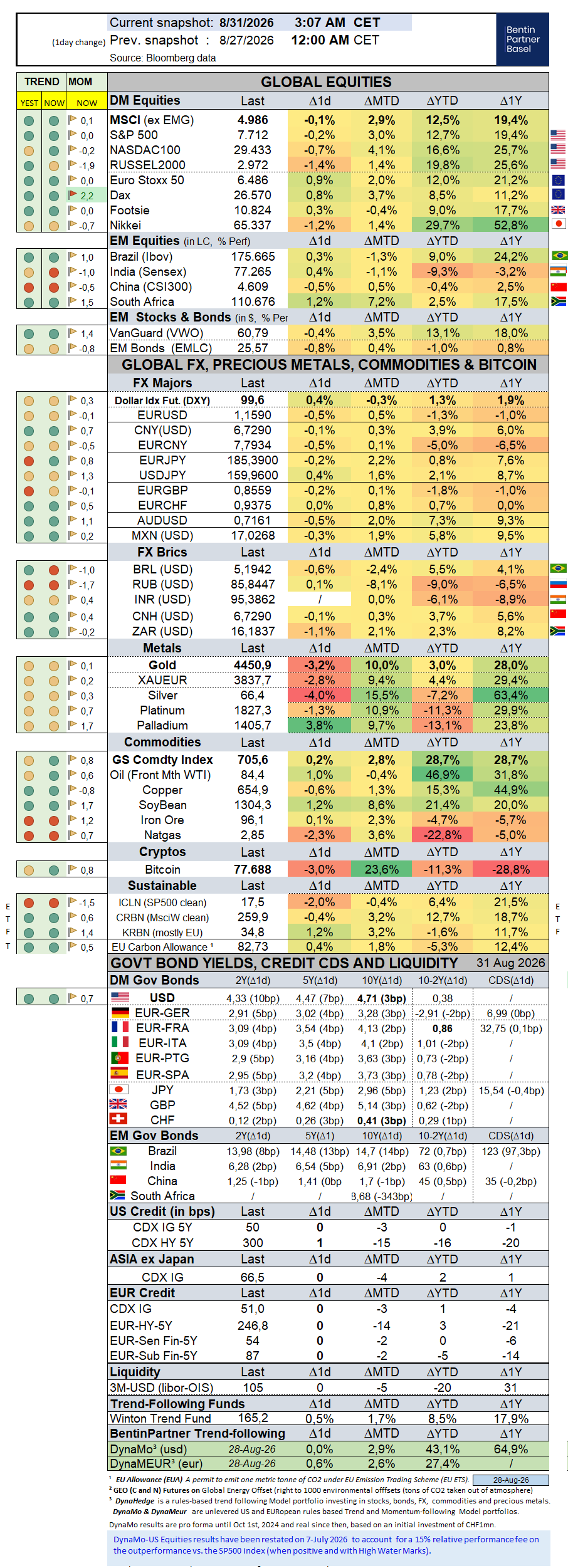
Over the past week, the S&P500 gained 0,5% (12,8% YTD) while the Nasdaq100 gained 0,4% (16,6% YTD). The US small cap index dropped -1,4% (20,1% YTD). AAPL rallied 3,3% (17,6%, Z-score 2,2).
The Equally Weighed SP500 dropped -0,4% (15,2% YTD), underperforming the S&P500 by-0,9%. The median SP500 YTD return closed the week at 9,7%.
Cboe Volatility Index sold off by -4,6% (-3,5% YTD) to 14,43.The Eurostoxx50 gained 0,4% (14,3%), matching the S&P500.
Diversified EM equities (VWO) gained 0,6% (13,1%), outperforming the S&P500 by 0,1%.
The Dollar DXY Index (UUP) measuring the USD performance vs. other G7 currencies gained 1,0% (4,3%) while the MSCI EM currency index (measuring the performance of EM currencies vs. the USD) gained 0,4% (3,9%).
10Y US Treasuries rallied -2bps (55bps) to 4,72%.
10Y Bunds climbed 2bps (42bps) to 3,28%. 10Y Italian BTPs climbed 2bps (55bps) to 4,10%, matching Bunds.
10Y French OAT's rallied -1bps (56bps) to 4,13%, outperforming Bunds by -3bps.
US High Yield (HY) Average Spread over Treasuries dropped -9bps (-6bps ) to 2,60%. US Investment Grade Average OAS dropped -3bps (3bps ) to 0,87%.
In European credit markets, EUR 5Y Senior Financial Spread climbed 0bps (0bps) to 0,54%.
Gold sold off by -3,2% (3,1%) while Silver sold off by -3,8% (-7,4%). Major Gold Mines (GDX) sold off by -3,1% (16,2%).
Goldman Sachs Commodity Index dropped -1,5% (37,7%). WTI Crude sold off by -4,2% (45,2%).
Overnight in Asia…
S&P future -30 points; Hong Kong -0.7%; Nikkei -1.1%; China -0.8%
Asian stocks fell with US equity-index futures while oil rose 2% as Middle East tensions resurfaced as the US military struck Iranian rocket launchers overnight, ending weeks of relative calm. Iran responded with a missile-and-drone attack on US air bases in Jordan.
In a referendum over the week end, Iceland rejected the reopening of negotiations to join the EU. A scant consolation, the Economist wrote, is that “10 countries with a combined population of 150mn have formally applied to join the EU, all of them being poor, most of them with dysfunctional politics and one at war”. A somewhat dysfunctional EU is now trying to rush to take those in…
China's manufacturing PMI was above economist estimates in August. Manufacturing PMI was 49.8 (estimate 49.5) in August.

To learn more about our AMC offering and how to invest in the trend-following, visit our Advisory web page.
If you like our Weekly, you will love our Daily!
Consider a subscription today. Discounts may apply!
To learn more about us and how we can assist you, check our website
Important Disclaimer
© Copyright by BentinPartner LLC. This communication is provided for information purposes only and for the recipient's sole use. Please do not forward it without prior authorization. It is not intended as a recommendation, an offer, or solicitation for the purchase or sale of any security or underlying asset referenced herein or investment advice. Investors should seek financial advice regarding the suitability of any investment strategy based on their objectives, financial situation, investment horizon, and particular needs. This report does not include information tailored to any particular investor. It has been prepared without any regard to the specific investment objectives, financial situation, or particular needs of any person who receives this report. Accordingly, the opinions discussed in this report may not be suitable for all investors. You should not consider any of the content in this report as legal, tax, or financial advice. The data and analysis contained herein are provided "as is" and without warranty of any kind. BentinPartner LLC, its employees, or any third party shall not have any liability for any loss sustained by anyone who has relied on the information contained in any publication published by BentinPartner LLC. The content and views expressed in this report represent the opinions of Marc Bentin and should not be construed as a guarantee of performance with respect to any referenced sector. We remind you that past performance is not necessarily indicative of future results. Although BentinPartner LLC believes the information and content included in this report have been obtained from sources considered reliable, no representation or warranty, express or implied, is provided in relation to the accuracy, completeness, or reliability of such information. This Report is also not intended to be a complete statement or summary of the industries, markets, or developments referred to in the Report.

Comments