Echos from the 2008 Financial Crisis...

BentinPartner Weekly

Dear Reader,
Please find below our latest Weekly Trend Report.
Have a nice start of the week.
Marc Bentin,
Bentinpartner GmbH
US stocks gained a little over 1% last week despite tech underperforming, more private credit woes, Fed minutes suggesting forthcoming US rate hikes “could” be as likely as rate cuts, war mongering surrounding a possible strike on Iran and Friday’s Supreme Court decision compromising or at least complicating D. Trump’s tariffs policy.
Nasdaq underperformed for another week with tech companies expected to add over USD1trn in debt despite scant evidence the AI technology can be sufficiently monetized to justify the borrowing binge. The eight largest (tech) companies with AI ambitions still constitute half of the S&P 500 index. A record number of investors said companies are spending far too much, the latest BoA fund manager survey showed despite those investors remaining the most bullish since June 2021...
Microsoft, Alphabet, Meta, Amazon, and Oracle together still enjoy enormous cash-flow and cash holdings. Still, devoting massive cash flows and taking on more debt, as the frantic AI arms race pursuits, significantly alters these companies’ risk profiles, analysts opined, not to mention that their unparalleled capacity for massive stock buybacks constitutive of powerful market liquidity backstops is also being questioned.
Private credit remained lined up to supply much of the data-center buildouts, Morgan Stanley wrote which will further concentrate AI into private credit, essentially sucking up most of the oxygen away from debt markets.
At the same time, private credit woes resurfaced with acuity last week after Blue Owl said it will permanently restrict investors from withdrawing their cash from its private retail debt fund, backtracking from an earlier plan to reopen to redemptions this quarter, saying it was instead liquidating USD1.4bn in assets to raise money to pay out individuals wanting to get out. Stocks across the private-fund industry slid as the deal raised questions about how much fund managers can count on individuals to stay invested in hard-to-sell assets for the long term with Blue Owl's stock shedding 10% at one point last Thursday and closing down nearly -12% on the week while shares of other private-credit providers also sank, including Apollo and Blackstone which dropped -4.1% and -6% last week. Developments at Blue Owl raised some liquidity concerns, accelerating the shift from risk appetite to risk aversion. “Is this a ‘canary-in-the-coal mine’ moment, similar to August 2007? Economist Mohamed El-Erian asked, saying “…the changes echo the early days of the 2008 financial crisis, although nowhere near the same magnitude”.
In conjunction with growing doubts about forthcoming rate cuts, a top Federal Reserve official accused the White House of escalating its attack on the central bank after it claimed US businesses and consumers were shouldering the bulk of the costs from D. Trump’s tariffs. K. Hassett, director of the National Economic Council, described the recent study from the New York Fed as ‘an embarrassment’ … ‘It’s I think the worst paper I’ve ever seen in the history of the Federal Reserve system,’ Hassett told CNBC. ‘The people associated with this paper should presumably be disciplined.’ He added: ‘What they’ve done is they’ve put out a conclusion which has created a lot of news that’s highly partisan based on analysis that wouldn’t be accepted in a first semester econ[omics] class’.” While Hassett subsequently apologized for his “emotional” comment, it was blatantly it was consistent with leaning on threats and coercion (to influence and silence) the Fed,
Furthermore, the Trump administration appeared closer to a major war in the Middle East. A US military operation in Iran would likely be a massive, weeks-long campaign that would look more like full-fledged war than last month's operation in Venezuela. There is a view that war with the US is now inevitable. Still, Washington said it had agreed to give Tehran two weeks to close the gaps between the sides. “President Trump said he is going to be ‘involved indirectly’ in the second round of nuclear talks between the U.S. and Iran that will take place in Geneva… Asked if he wanted regime change in Iran, Trump responded that it ‘seems like that would be the best thing that could happen.’ He declined to share who he wanted to take over Iran, but said ‘there are people.’
Finally, “President D. Trump rushed to salvage his tariffs policy after the Supreme Court struck down his global duties, pledging he would use different tools to work around the ruling and preserve import taxes he has cast as essential to his economic and foreign policy. The president said… he planned to impose a flat 10% levy on foreign goods in the coming days, and that he would order a raft of trade investigations that should allow him to enact more permanent tariffs. In a defiant White House press conference hours after the decision, Trump vowed to forge ahead with his approach despite complaints from opponents who say it has undercut longtime trade partnerships and increased costs for Americans. The president has credited his tariff regime for driving substantial investments in the US and preventing foreign conflicts.”
On currencies and for the week, the dollar index rose 0.9% (- 0.5% YTD) on higher risk aversion despite a majority of big investors expecting Kevin Warsh’s appointment to lead the Federal Reserve will cause the dollar to weaken further (on lost independence).
The Economist cited a February IMF study last week reflecting the fact that CNY is “China’s currency but the world’s problem”, likely undervalued by between 16% and 19% based on its current trade surplus and that a normalization of this imbalance is required to balance the world economy, including to strengthen China’s local economy.
Also on China Rory Green, TS Lombard’s chief China economist and head of Asia research, told CNBC, “China’s rapid advancement in AI is threatening to shake up U.S. dominance in the market, with one analyst warning of a tech shock that is just getting started. … America’s ‘perceived monopoly’ on tech and AI has been broken by China. ‘I think the China tech shock is just getting started. It’s not just AI, DeepSeek, and electric vehicles. China is moving up the value chain very rapidly... It’s the first time in history that an emerging market economy is at the forefront of science and technology,’ Green said… China is pairing dominant-market level tech with emerging-market production costs, backed by its massive supply chain, Green said.”
Crude oil surged 5.7% last week to an eight-month high, as the war premium built in while Gold jumped 1.3% and silver rallied 9.3%. Iran’s government said it will ‘defend itself and respond like never before’ should US President Donald Trump follow through on threats to attack the country
Russia also said it could deploy its navy to prevent European powers from seizing its vessels and may retaliate against European shipping if Russian ships are taken, Nikolai Patrushev, one of Russia’s leading hardliners. Europe subsequently failed to agree on a 20th train of Russian sanctions in what appeared as a major setback to the EU Commission as several countries blocked the decision (including Greece and Malta).
The latest US-brokered talks between envoys from Moscow and Kyiv over Russia’s invasion of Ukraine ended Wednesday with no sign of a breakthrough and with both sides saying the talks were ‘difficult,’ Negotiations in Switzerland were the third round of direct talks organized by the U.S., after meetings earlier this year in Abu Dhabi that officials described as constructive but which also made no major headway.
Ukraine’s V. Zelenskiy told US President D. Trump was exerting undue pressure on him in trying to secure a resolution to the nearly four-year-old war pitting Kyiv against Moscow. Zelenskiy also said any plan requiring Ukraine to give up territory that Russia had not captured in the eastern Donbas region would be rejected by Ukrainians if put to a referendum (which will likely also end his term as President when an election will be allowed to take place).
On the economic side, Markets, economists and Federal Reserve officials seem to believe that the US labor market spent most of last year weakening, that inflation is trending back to the Fed’s inflation target and that the central bank will continue cutting interest rates in 2026. On each of these three points, the conventional view is probably wrong, some analysts opined citing recent data.
US applications for unemployment benefits fell last week as layoffs remained at historically low levels. The number of Americans filing for jobless aid for the week ending Feb. 14 fell by 23,000 to 206,000 from the previous week... Prior to this, in January, the economy added 130,000 net new jobs and the unemployment rate declined by 10 bps to 4.28%...but the credibility of that data set is structurally weak.
That said, US orders for business equipment also increased in December by more than expected, suggesting solid capital investment…but we know what drives this capex spending…and how it is possibly artificially inflated.
Finally, New residential construction in the US rose to a five-month high in December…with Housing starts increased 6.2% to an annual pace of 1.4 million homes in December, beating estimates.
More recently, however, the average discount for U.S. homes that sold below their original asking price last year was nearly 8% — the largest such gap since 2012, according to… Redfin… with still-high mortgage rates and home prices weighing on sentiment. “US homebuilders’ confidence slipped again this month... An index of market conditions from the National Association of Home Builders and Wells Fargo edged down in February to 36, the lowest level since September…
Elsewhere in Japan, the economy expanded at 0.2% annual pace in the last quarter…, with growth for all of 2025 at just 1.1%, likely to convince Prime Minister Sanae Takaichi to roll out policies to help revive the economy after a landslide victory in a general election earlier this month.
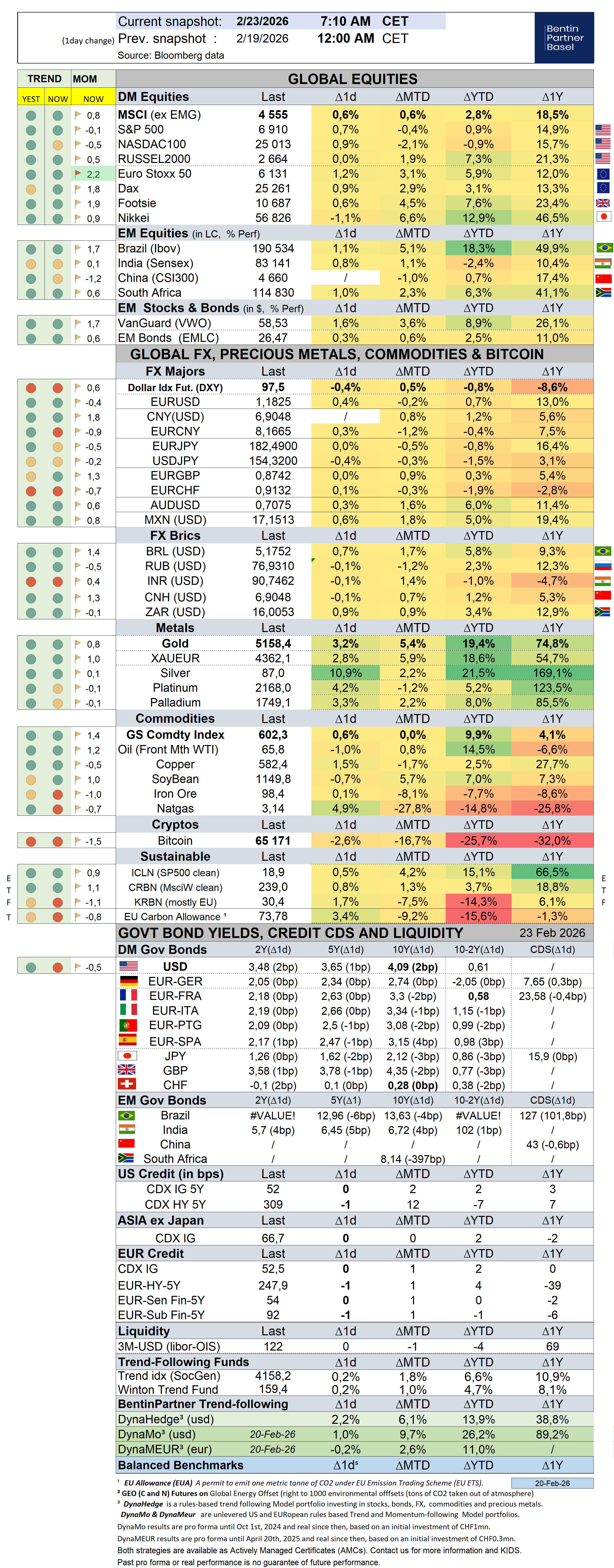
Over the past week, the S&P500 gained 1,2% (1,1% YTD) while the Nasdaq100 gained 1,4% (-0,9% YTD). The US small cap index gained 2,0% (7,5% YTD). AAPL gained 1,1% (-2,7%).
The Equally Weighed SP500 gained 1,6% (6,5% YTD), outperforming the S&P500 by 0,4%. The median SP500 YTD return closed the week at 7,1%.
Cboe Volatility Index sold off by -8,3% (27,7% YTD) to 19,09.
The Eurostoxx50 rallied 2,4% (5,8% , Z-score 2,2), outperforming the S&P500 by 1,2%.
Diversified EM equities (VWO) gained 1,3% (8,9%), outperforming the S&P500 by 0,1%.
The Dollar DXY Index (UUP) measuring the USD performance vs. other G7 currencies gained 1,0% (0,2%) while the MSCI EM currency index (measuring the performance of EM currencies vs. the USD) gained 0,0% (1,0%).
10Y US Treasuries dropped 3bps (-8bps ) to 4,08%. 10Y Bunds dropped -2bps (-12bps) to 2,74%. 10Y Italian BTPs dropped -2bps (-21bps ) to 3,34%, outperforming Bunds by 0bps.
10Y French OAT’s rallied -4bps (-26bps) to 3,30%, outperforming Bunds by -2bps.
US High Yield (HY) Average Spread over Treasuries dropped -10bps (4bps ) to 2,70%. US Investment Grade Average OAS dropped -2bps (0bps) to 0,84%.
In European credit markets, EUR 5Y Senior Financial Spread dropped -1bps (0bps) to 0,54%.
Gold gained 1,3% (18,2%) while Silver rallied 9,3% (18,1%). Major Gold Mines (GDX) rallied 8,1% (23,9%).
Goldman Sachs Commodity Index rallied 3,4% (10,0%). WTI Crude rallied 5,8% (15,8%).
Overnight in Asia…
S&P future -51 points; Hong Kong +2.2%; Nikkei -1.2%; China -1.2%
US stock futures dropped overnight on uncertainty over US trade policy, dampening sentiment toward American assets while in contrast, most Asian markets gained. China, India and Brazil are among the countries seeing lower tariff rates for shipments to the US after the Supreme Court struck down Trump's emergency levies. The weighted average tariff rate for Asia will fall to 17% from 20%, with average levies on goods from China declining to 24% from 32%. Losers include economies such as the UK and Australia that had negotiated lower levies of 10% under the old framework, and will now face a 15% global rate, Bloomberg wrote.
Gold and silver rallied sharply as China returned from Golden week amidst a wave of risk aversion.
Bitcoin dropped below 65k overnight (trading at some point 5% lower in an hour despite gold and silver rallying) as deleveraging in the space continued (335’000 traders were reportedly liquidated over the recent past accompanying forced deleveraging in the crypto space).
Students in Iran staged anti-government rallies at several universities for a second day, testing a fragile calm imposed after last month’s deadly crackdown on protests, Bloomberg wrote. The two weeks negotiating delay is also clearly serving the purpose of fueling resentment from within Iran in the hope of helping regime change especially after D. Trump promised he was sending help last month which seems to be lined up. A direct military confrontation is holding much more risks …
E. Macron wrote to D. Trump asking him to lift sanctions imposed on officials including former EU Commissioner Thierry Breton. Macron said the sanctions against Breton undermine European regulatory autonomy and are based on erroneous analysis. This message will likely fall on deaf ears for a while given the way it was asked and considering that the EU has itself arbitrarily imposed heavy administrative sanctions on people like internationally recognized Swiss former Colonel J. Baud, for only presenting documented facts that are not in unison with the European doxa (some would call it propaganda) on the war in Ukraine, depriving him from basic human rights despite violating no national (or European) law, in absence of any hearing or condemnation pronounced by any court in what constitutes a clear infringement of the freedom expression in Europe which the DSA (fathered by T. Breton) threatens to only exacerbate. Similar threats to the basic right of free expression are a material US reproach and bone of contention poisoning US-EU relations and one unlikely to be addressed by a plea to lift sanction on T. Breton.

To learn more about our AMC offering and how to invest in the trend-following, visit our Advisory web page.
If you like our Weekly, you will love our Daily!
Consider a subscription today. Discounts may apply!
To learn more about us and how we can assist you, check our website
Important Disclaimer
© Copyright by BentinPartner LLC. This communication is provided for information purposes only and for the recipient's sole use. Please do not forward it without prior authorization. It is not intended as a recommendation, an offer, or solicitation for the purchase or sale of any security or underlying asset referenced herein or investment advice. Investors should seek financial advice regarding the suitability of any investment strategy based on their objectives, financial situation, investment horizon, and particular needs. This report does not include information tailored to any particular investor. It has been prepared without any regard to the specific investment objectives, financial situation, or particular needs of any person who receives this report. Accordingly, the opinions discussed in this report may not be suitable for all investors. You should not consider any of the content in this report as legal, tax, or financial advice. The data and analysis contained herein are provided "as is" and without warranty of any kind. BentinPartner LLC, its employees, or any third party shall not have any liability for any loss sustained by anyone who has relied on the information contained in any publication published by BentinPartner LLC. The content and views expressed in this report represent the opinions of Marc Bentin and should not be construed as a guarantee of performance with respect to any referenced sector. We remind you that past performance is not necessarily indicative of future results. Although BentinPartner LLC believes the information and content included in this report have been obtained from sources considered reliable, no representation or warranty, express or implied, is provided in relation to the accuracy, completeness, or reliability of such information. This Report is also not intended to be a complete statement or summary of the industries, markets, or developments referred to in the Report.

Comments