PPT...

BentinPartner Weekly

Dear Reader,
Please find below our latest Weekly Trend Report.
Have a nice start of the week.
Marc Bentin,
Bentinpartner GmbH
Last week’s major event was the downfall of a 22-year old “wunderkind” (“Leopold Aschenbrenner, a former Opean AI researcher) who had worked at FTX’s Future Fund (Sam Bankman-Fried) who had raised his AUM to USD45bn at some point in July for his “Situational Awareness” hedge fund before dropping -67% in a couple of weeks, triggering the emergency forced buyout of his remaining assets by Citadel on Thursday to prevent a further fire sale liquidation that was wreaking havoc with the US stock market with his failing hyper leveraged and concentrated bet on the most speculative AI names.
Two years ago, Leopold Aschenbrenner argued he was one of few people in the world who saw the future clearly. While the US market was in dire straight as the liquidation was unfolding, news of the bailout triggered a significant short squeeze in the segment that spilled over to market as a whole, triggering significant volatility, both down and up throughout the week but ending with a big rally as events unfolded.
What started as a fairly poor week ended in all round optimism, supported by some good but also contrasted earnings reports which caused high double digits moves in large cap tech names such as AAPL (-8% on Friday) and AMZN (+14% on Friday).
Despite healing risk conditions, stock price and breadth moved in opposite direction as the rally took place, translating into the worst breadth ever witnessed on a day when the SP500 gained 1.5%.
It was also the first day when the SP500 gained 1.5% and the Equally weighed SP500 index (RSP) actually declined, suggesting that the overall index gains were traceable to only a very limited number of heavily weighed stocks in the SP500 (AMZN on Friday) while most other stocks declined.
Some analysts argued that the first bailout is always the easiest one. Chances are indeed that there are more Leopold around suffering cold sweat and who ushered a sigh of relief as the week unfolded.
Most of the chips pain boiled down to developments in Korea. Friday delivered the single best one day performance for the KOSPI (+19%) while still closing its worst month since the GFC while posting an average weekly move so far this year of 21%.
Large drawdowns are often followed by epic squeezes before more selling emerges.
This has been a pattern for all bear markets in the past, not to say that we are in the midst of one. We are just in the midst of heavily manipulated and overvalued markets with too much retail leverage (although Goldman reported the second single largest de-grossing event last week), plenty of Presidential TACO’s to look forward to ahead of the approaching primaries (yesterday was TACO Sunday as well), and timely covered PPT intervention in the futures markets occurring each time at key support levels in both equity and oil futures with now, and to top it all off, a serious FX coordinated intervention.
Also coming in support of a near term bullish outlook is the seasonality of share buybacks for which August is typically the most active month.
I believe the level of “Situational awareness” by the Fed and Treasury to be near peak Covid levels (we know what happened then) and that is another bullish technical and short-term signal.
Whether (obvious) market manipulation can last forever is another question but the tools in the toolkit are aplenty and the firepower technically infinite. When you can buy futures without initial margin requirements, you can push the market higher with no QE, at the margin which is for the SP500 the only thing that matters. Selling begets more selling and buying begets more buying. If it does not fall on technical grounds, it will creep back up again for the same reasons with volume coming after the marginal mystery buyer deployed the safety net that kept the market from breaking through supports.
While stock market developments were encouraging last week, this occurred despite bond markets not playing ball with US treasury yields rising (I believe mostly related to JPY intervention) but at the same time European yields rose more than US ones. The sort of moves we have seen (2 sigma moves) are typically bond market moves that stocks pay attention to and start bowing under as well but this may have been more related to the JPY intervention and bonds closed well off their worst levels of the week as well.
While they declined from their worst levels of early last week, 30Y credit spread of hyperscalers remained high on the heat map, closing ending July 30bps wider than at the end of June (at 157bps), a story worth following to assess hyperscalers’ affordability for their gigantic capex spending plans.
The other major event, this time in FX occurred on the same day (on Thursday) when Japan carried out after leaving interest rates unchanged one more time, a large, sudden, yen buying intervention yesterday, causing USD/JPY to collapse by more than 5 yen in minutes in an empty market after the US and Asian markets closed.
At the same time the Fed was reported to have “checked rates”, the central bank wording to signify that MoF was not alone to implement the scare tactic in an effort to bring JPY devaluation to a halt after JPY touched a 40-years low against the USD. To be credible, this effort needs to be sustained and this is what has happened ever since with the US Treasury reporting over the week end it would be there to further help with this intervention if necessary. Last Friday, the FT reported that the Fed sold EUR for JPY on behalf of the US Treasury in the first joint intervention in 30 years after JPY reached its weakest level since 1986 earlier last week. This intervention spun a slightly negative bias on the US dollar index as a whole last week.
The side effect of this intervention was a further US bond market decline (to buy JPY, MOF needs to sell USD and Us treasuries) which the stock market took in stride, still confident this will be a short term move in yields with little follow through.
Precious metals continued to trade in a volatile and frustrating manner for the bulls as a slightly weaker dollar and higher US yields prevented any rally to hold. I continue to believe that the bottom is near but perhaps that is my old school broken record playing again (never mind I still like it).
President Trump’s war in Iran is showing all signs of going wrong (for him). And Europe’s war in Ukraine is going equally wrong with Ukraine on the verge of losing access to the Black sea (the port of Odessa) risking to become a landlocked country, exposing the country to the risk of not being able to export its overflowing agricultural goods.
While some analysts flagged the risk about Ukraine’s Zelinski trying to link the two conflicts (including by hitting a cargo last week that was heading for Russia), the reality on the ground could actually suggest that we are nearing an end of perhaps not one but both conflicts with at least more decisive progress in sight for a halt of hostilities because Iran maintains its strangulation strategy of hitting Middle East infrastructure (and US military bases) harder as retribution for each US bombing campaign and with Russia now strangulating the economic nerve of Ukraine.
At the end of the day, it is the economy that will dictate what happens with both conflicts and Europe’s economic (and political) situation is also getting worse by the day with internal conflicts and disunity getting harder and harder to cover up. The week end’s Spanish border invasion will in that respect create another optics disaster for the open border left across Europe, looking at illegal migrants and their subsequent legalization as a last resort measure to rescue their fainting political support and legitimacy.
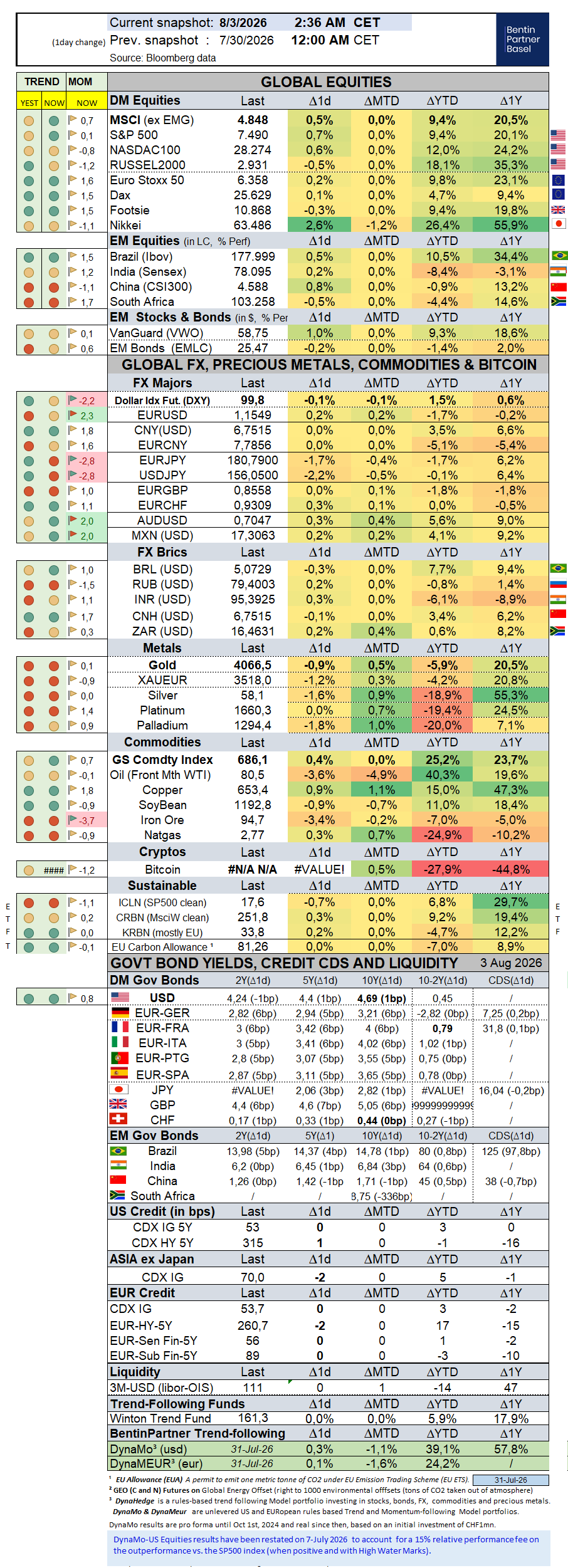
Over the past week, the S&P500 gained 1,1% (9,5% YTD) while the Nasdaq100 gained 0,5% (12,0% YTD). The US small cap index was unchanged (18,3% YTD). AAPL shed -7,2% (13,6%).
The Equally Weighed SP500 gained 0,7% (12,2% YTD), underperforming the S&P500 by-0,4%. The median SP500 YTD return closed the week at 8,5%.
Cboe Volatility Index sold off by -13,9% (7,0% YTD) to 15,99.
The Eurostoxx50 gained 1,3% (11,9%), outperforming the S&P500 by 0,2%.
Diversified EM equities (VWO) gained 1,6% (9,3%), outperforming the S&P500 by 0,5%.
The Dollar DXY Index (UUP) measuring the USD performance vs. other G7 currencies dropped -1,4% (4,2%) while the MSCI EM currency index (measuring the performance of EM currencies vs. the USD) gained 1,0% (2,2%).
10Y US Treasuries dropped 4bps (52bps) to 4,69%. 10Y Bunds climbed 3bps (35 bps) to 3,21%. 10Y Italian BTPs climbed 2bps (47bps) to 4,02%, outperforming Bunds by -1bps.
10Y French OAT’s dropped 3bps (44bps) to 4,00%, matching Bunds.
US High Yield (HY) Average Spread over Treasuries dropped -1bps (13bps) to 2,79%. US Investment Grade Average OAS dropped -1bps (4bps) to 0,88%.
In European credit markets, EUR 5Y Senior Financial Spread was unchanged (1bps) to 0,56%.
Gold dropped -0,2% (-5,8%) while Silver dropped -0,5% (-18,9%). Major Gold Mines (GDX) dropped -1,5% (-13,6%).
Goldman Sachs Commodity Index sold off by -2,2% (31,7%). WTI Crude sold off by -2,6% (40,1%).
Overnight in Asia…
Ø S&P future +45 points; Hong Kong +0.1%; Nikkei -1%; China -0.7%
Ø While on Friday, President D. Trump vowed to hit Iran hard again (using plenty of MMA analogies), a phone call form from Saudi Prince MBS was enough to quiet him down, claiming instead that Iran was asking for relief and negotiation. President D. Trump said new Iran talks would begin Monday afternoon (after the US market open).
Ø “It would have been the biggest attack since World War II,” Trump said Sunday to reporters on Air Force One. “We’re just going to see whether or not we can make a deal.”
Ø Brent oil for October fell as much as 7.3% to $81.55 a barrel in early trading Monday, after surging more than 20% in July. That said, price means little. Let’s see if quantity follows which can only occur with a normalization of SoH traffic.
Ø JPY gained 0.7% on more intervention talks. US Treasury Secretary Bessent left on his desk for Reuters to photograph a To Do List including a single item “Buy JPY (5 to 10 bn) as evidence of his determination.

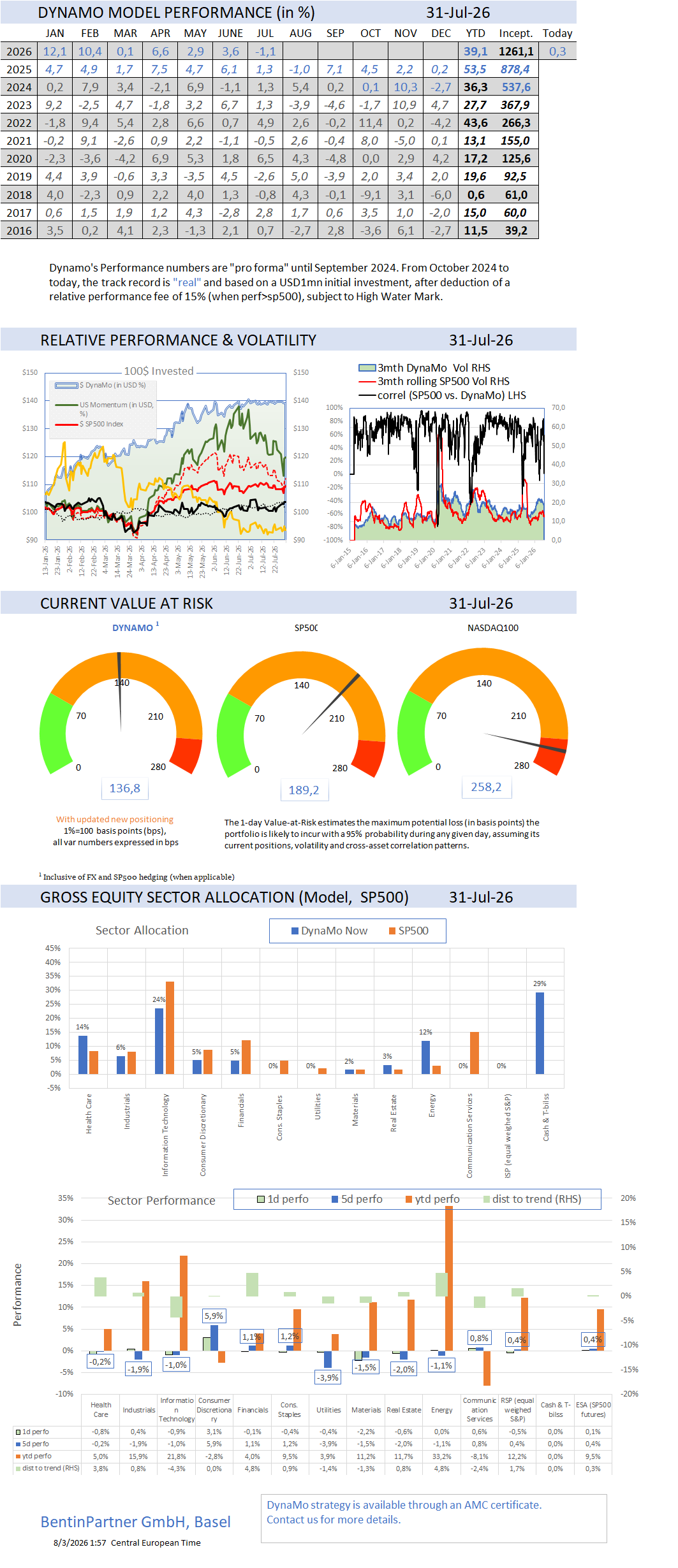
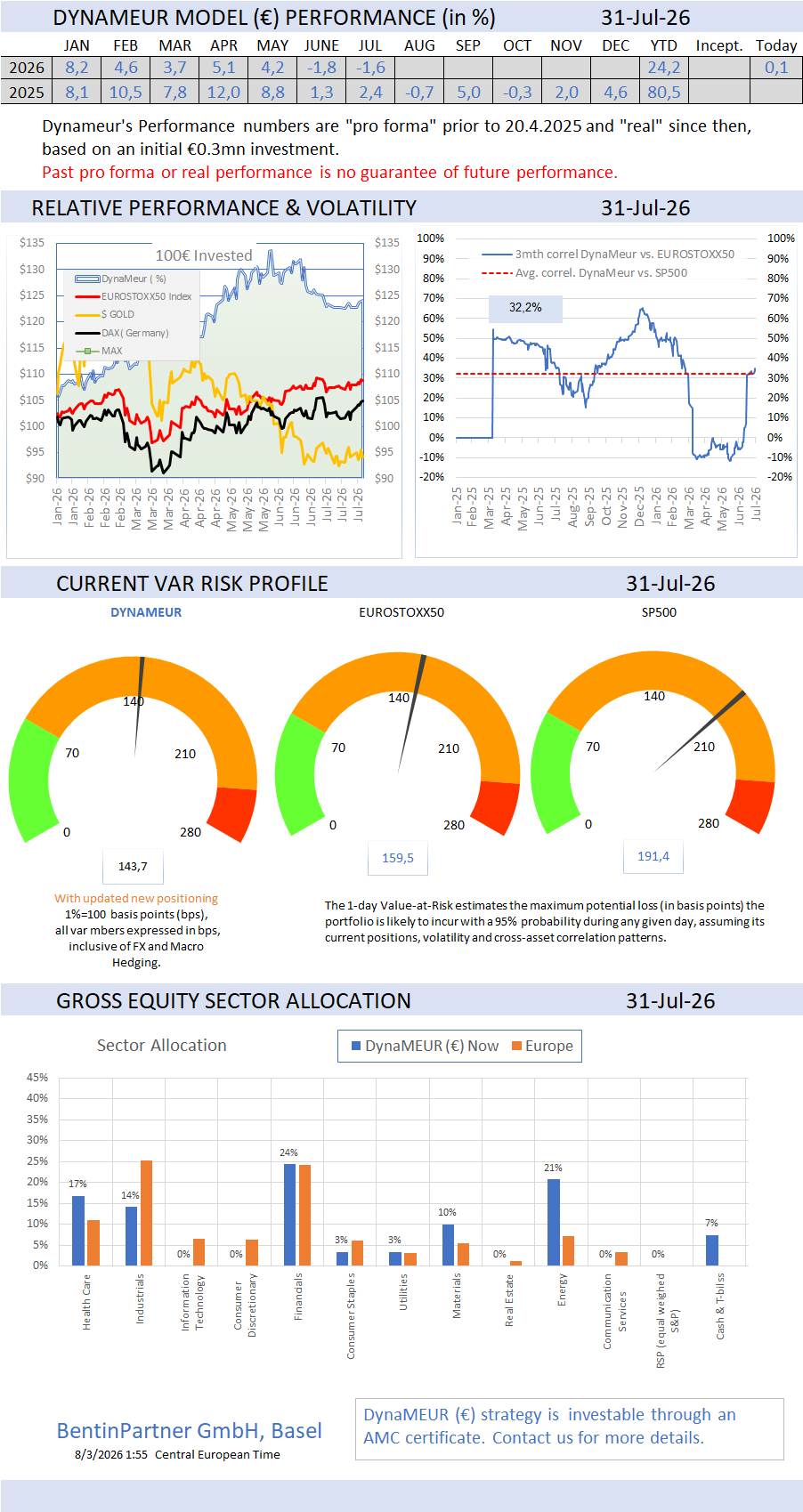
To learn more about our AMC offering and how to invest in the trend-following, visit our Advisory web page.
If you like our Weekly, you will love our Daily!
Consider a subscription today. Discounts may apply!
To learn more about us and how we can assist you, check our website
Important Disclaimer
© Copyright by BentinPartner LLC. This communication is provided for information purposes only and for the recipient's sole use. Please do not forward it without prior authorization. It is not intended as a recommendation, an offer, or solicitation for the purchase or sale of any security or underlying asset referenced herein or investment advice. Investors should seek financial advice regarding the suitability of any investment strategy based on their objectives, financial situation, investment horizon, and particular needs. This report does not include information tailored to any particular investor. It has been prepared without any regard to the specific investment objectives, financial situation, or particular needs of any person who receives this report. Accordingly, the opinions discussed in this report may not be suitable for all investors. You should not consider any of the content in this report as legal, tax, or financial advice. The data and analysis contained herein are provided "as is" and without warranty of any kind. BentinPartner LLC, its employees, or any third party shall not have any liability for any loss sustained by anyone who has relied on the information contained in any publication published by BentinPartner LLC. The content and views expressed in this report represent the opinions of Marc Bentin and should not be construed as a guarantee of performance with respect to any referenced sector. We remind you that past performance is not necessarily indicative of future results. Although BentinPartner LLC believes the information and content included in this report have been obtained from sources considered reliable, no representation or warranty, express or implied, is provided in relation to the accuracy, completeness, or reliability of such information. This Report is also not intended to be a complete statement or summary of the industries, markets, or developments referred to in the Report.
Comments