Not Even Worth Being Called a War...

BentinPartner Weekly

Dear Reader,
Please find below our latest Weekly Trend Report.
Have a nice start of the week.
Marc Bentin,
Bentinpartner GmbH
US equities ended the week essentially unchanged after several sessions that felt both lackluster and uneventful. Once again, bonds dominated the narrative: US Treasury yields climbed another 6 bps to 4.78%, while international government debt posted similar declines, leaving the global fixed‑income backdrop looking increasingly strained. Japanese 10‑year yields briefly touched a 30‑year high at 3% before easing back.
Credit markets did not escape the pressure either. Spreads widened over the week, and redemption requests at Blackstone’s flagship private credit fund held at roughly 10% in Q3, the same elevated level as the previous quarter.
Geopolitically, the Russia–Ukraine confrontation intensified, with both sides launching continuous strikes on ports and commercial vessels. A faint glimmer of hope appeared over the weekend as President Vladimir Putin met with two US special envoys in an attempt to revive peace discussions.
The Iranian front deteriorated further. Renewed US strikes triggered additional Iranian attacks on Middle Eastern infrastructure, US military bases in Jordan, and most recently on US naval assets stationed in the region. Washington appears to be playing for time while tightening economic pressure on Iran, but Tehran has shifted to a more offensive posture, aware that US midterm elections are approaching and that the probability of a Democratic sweep is rising. More destruction across the Middle East will inevitably weigh on US financial assets, as regional economies may need to liquidate US holdings (both equities and Treasuries) to fund repairs and compensate for crippled export revenues.
Despite this escalation, senior US officials, the Treasury Secretary, the Vice President, and the President, continued to downplay the conflict. VP Vance dismissed it as not even worthy of being called a war, while President Trump referred to it as “peanuts” and “small potatoes.” Such rhetoric does little to change the reality: significant damage to US military installations, a weakened US strategic position in the region, and a reputational hit both diplomatically and on the battlefield. The conflict is portrayed as so insignificant that, were the US to declare victory tomorrow and withdraw, it would supposedly pass unnoticed, a claim at odds with the facts on the ground.
It would be anecdotal if it were not so revealing of how completely astray US “diplomatic” behavior has become.
Last week, the US Ambassador to Belgium, Bill White, personally insulted a member of the Belgian government after Belgium tightened its alcohol‑warning rules, requiring brewers to print “alcohol damages your health” instead of the softer “alcohol abuse damages your health.” The change sparked domestic controversy among Belgian brewers. The fact that zero alcohol consumption is healthier than occasional drinking is hardly debatable. Still, nobody needs a nanny to tell them whether they should feel guilty about sharing a beer with friends, an activity that arguably has positive social and psychological effects that may outweigh the marginal extra work for the liver.
In any case, nobody in Belgium (or elsewhere) cares what Bill White thinks about this internal debate, and insulting a public official from his diplomatic position is both ridiculous and inappropriate. Perhaps he hoped to make inroads for US beer in Belgium. There is also a popular Belgian saying that dogs tend to imitate their master, perhaps the Ambassador objects to that too. Belgium’s Foreign Minister Prévot formally summoned him (for the second time this year) to deliver a reprimand and remind him of basic diplomatic norms.
It is through such small episodes that one sees how low US non‑diplomatic standards have fallen and, more importantly, how much of the world has grown tired of it.
Meanwhile, the US strategy of further straining the Iranian economy and forcing a stalemate. in the hope of bringing the Iranian regime to its knees, was met with a sudden resurgence in Iran’s military response. Iranian forces targeted US bases across the Middle East, especially in Jordan last week, and over the weekend directly struck US naval assets with hypersonic missiles. The US retaliated by hitting several Iranian tankers, sinking one.
As a result of this “non‑war” that some US officials have called “peanuts,” WTI surged another 9.7% last week, while natural gas gained 3%.
Following hawkish remarks by Kevin Warsh at Jackson Hole, which markets interpreted as pricing in a 25-bps tightening for September, both President Trump and Vice President Vance publicly urged the Fed to cut rates. “We are doing a lot of things to try to keep rates down, but it would be nice to have some help from the Federal Reserve,” Vance said, arguing that rate cuts would make housing more affordable.
In this context, US yields continued to rise last week. James Carville’s famous line … “I want to come back as the bond market because you can intimidate everybody” does not seem to be part of Trump’s intellectual repertoire, as he and S. Bessent appear determined to provoke further upward drift in yields. I maintain the view that nothing will stop yields from creeping higher except a full‑metal yield‑curve anchoring, which would be far more effective than incendiary political statements or Fed‑bullying born of frustration.
On the data front, the US trade deficit widened sharply in July, driven by a surge in computer imports.
While most releases last week pointed to a weakening labor market, Friday’s Non‑Farm Payrolls, a notoriously unreliable series, contradicted that narrative, reporting 162k new jobs versus 65k expected. This triggered a mild equity pullback on Friday, as it revived tightening expectations, compounded by renewed Middle East tensions pushing oil higher.
Elsewhere, Chinese data surprised on the upside, with manufacturing expanding after three months of contraction.
An ECB official warned that the US conflict of attrition is reinforcing expectations of a 25 bps ECB hike to 2.5% this week. EU inflation rose to 3.3% in August (from 2.9% in July), almost entirely driven by energy.
Japan’s budget requests climbed back to pandemic levels, and the BoJ Governor hinted at a likely rate hike later this month. Japan’s manufacturing sector improved in August, and its services sector expanded at the fastest pace in five months.
The dollar and precious metals slipped slightly last week, while commodities rallied, led by oil’s strong surge.
US markets will be closed today.
US PPI and CPI will be released Wednesday and Thursday, respectively, along with Oracle’s results, providing the Fed with its final data points before deciding whether to tighten policy on September 16.
As always, please confirm political statements with trusted sources.
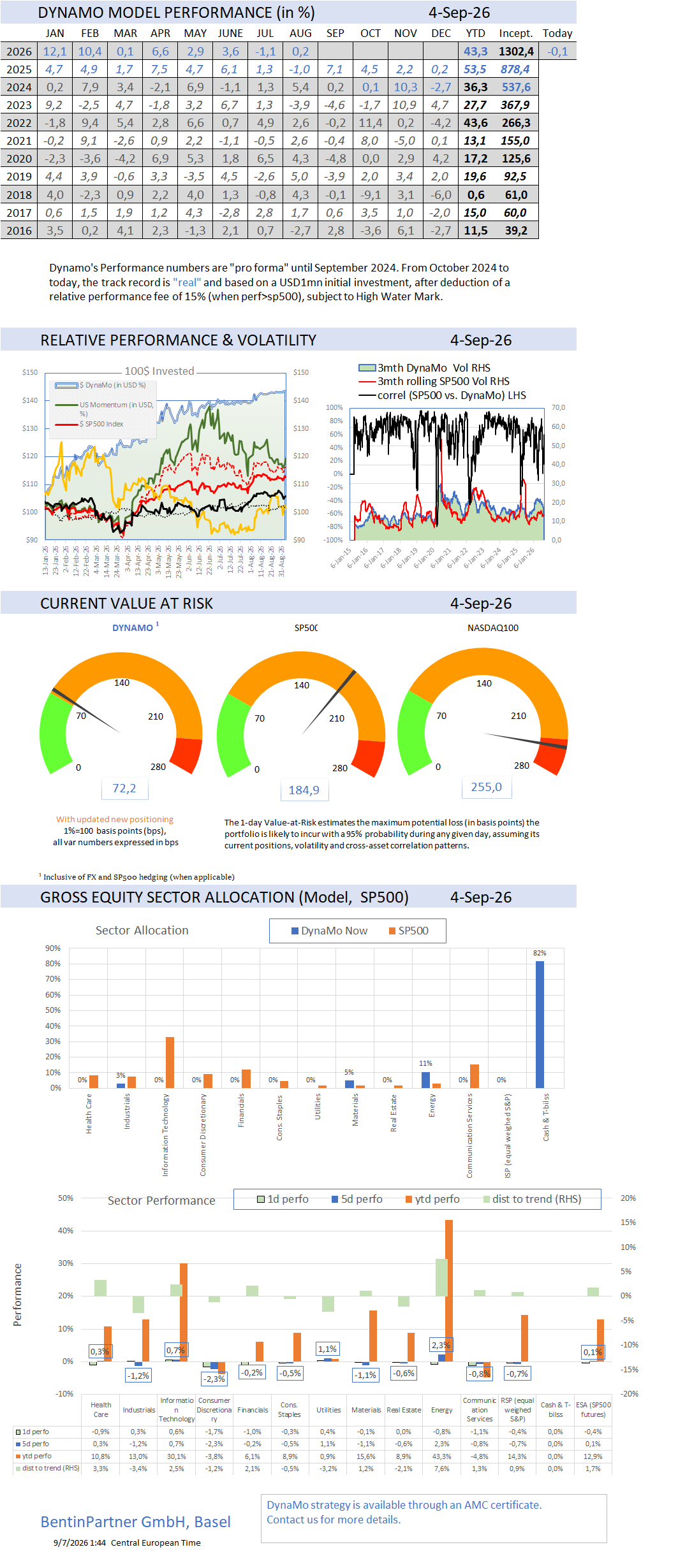
Over the past week, the S&P500 gained 0,1% (12,9% YTD) while the Nasdaq100 gained 0,4% (17,0% YTD). The US small cap index gained 0,1% (20,3% YTD). AAPL gained 0,1% (17,7%).
The Equally Weighed SP500 dropped -0,8% (14,3% YTD), underperforming the S&P500 by-0,9%. The median SP500 YTD return closed the week at 9,1%.
Cboe Volatility Index gained 0,7% (-2,8% YTD) to 14,53.
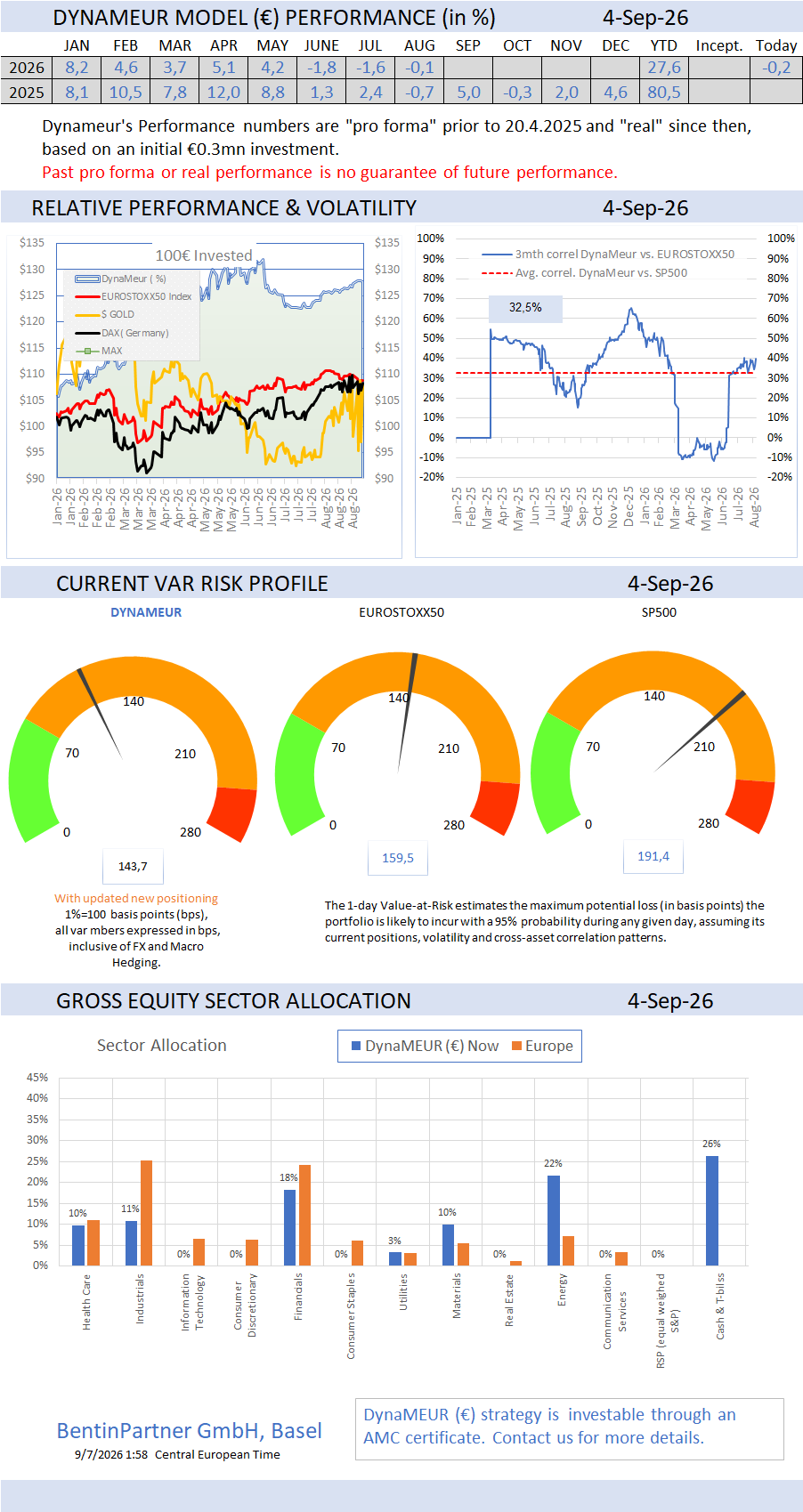
The Eurostoxx50 dropped -1,4% (12,7%), underperforming the S&P500 by-1,5%.
Diversified EM equities (VWO) gained 1,1% (14,3%, Z-score 2,4), outperforming the S&P500 by 1,0%.
The Dollar DXY Index (UUP) measuring the USD performance vs. other G7 currencies dropped -0,4% (3,9%) while the MSCI EM currency index (measuring the performance of EM currencies vs. the USD) gained 0,6% (4,5%).
10Y US Treasuries dropped 3bps (62bps) to 4,78%. 10Y Bunds climbed 6bps (48bps) to 3,34%. 10Y Italian BTPs climbed 5bps (60bps) to 4,15%, outperforming Bunds by -1bps.
10Y French OAT's underperformed rising 7bps (63bps) to 4,20%, underperforming Bunds by 1bps.
US High Yield (HY) Average Spread over Treasuries climbed 7bps (1bps) to 2,67%. US Investment Grade Average OAS climbed 2bps (5bps) to 0,89%.
In European credit markets, EUR 5Y Senior Financial Spread climbed 0bps (-1bps) to 0,54%.
Gold dropped -0,6% (2,6%) while Silver dropped -0,3% (-7,6%). Major Gold Mines (GDX) dropped -0,4% (15,7%).
Goldman Sachs Commodity Index rallied 3,6% (42,7%). WTI Crude rallied 9,7% (59,3%).
Overnight in Asia…
S&P future -8 points; Hong Kong -1%; Nikkei +2.2%; China +0.1%
China is injecting 300 billion yuan ($45 billion) into its largest banks and insurers, part of the nation’s biggest recapitalization in almost two decades, to shore up the strength of its financial system and sustain lending as economic growth slows, Bloomberg reported.
The AfD secured 44% of the vote in the eastern state of Saxony-Anhalt, more than doubling its support and putting it ahead of the long-governing Christian Democratic Union, whose backing collapsed to 17.5%, according to a projection broadcast by ARD. That would leave the AfD only three seats short of an outright majority in the state legislature.
Iran and the US carried out what appeared to be their largest tit-for-tat tanker strikes yet over the weekend, pushing oil prices higher as both nations continue to escalate a six-month war that has disrupted shipping and stoked global inflation, Bloomberg reported. Mohammad Bagher Ghalibaf, the speaker of Iran’s parliament and lead negotiator in previous ceasefire talks, on Sunday warned the era of “proportionate responses” was over.


To learn more about our AMC offering and how to invest in the trend-following, visit our Advisory web page.
If you like our Weekly, you will love our Daily!
Consider a subscription today. Discounts may apply!
To learn more about us and how we can assist you, check our website
Important Disclaimer
© Copyright by BentinPartner LLC. This communication is provided for information purposes only and for the recipient's sole use. Please do not forward it without prior authorization. It is not intended as a recommendation, an offer, or solicitation for the purchase or sale of any security or underlying asset referenced herein or investment advice. Investors should seek financial advice regarding the suitability of any investment strategy based on their objectives, financial situation, investment horizon, and particular needs. This report does not include information tailored to any particular investor. It has been prepared without any regard to the specific investment objectives, financial situation, or particular needs of any person who receives this report. Accordingly, the opinions discussed in this report may not be suitable for all investors. You should not consider any of the content in this report as legal, tax, or financial advice. The data and analysis contained herein are provided "as is" and without warranty of any kind. BentinPartner LLC, its employees, or any third party shall not have any liability for any loss sustained by anyone who has relied on the information contained in any publication published by BentinPartner LLC. The content and views expressed in this report represent the opinions of Marc Bentin and should not be construed as a guarantee of performance with respect to any referenced sector. We remind you that past performance is not necessarily indicative of future results. Although BentinPartner LLC believes the information and content included in this report have been obtained from sources considered reliable, no representation or warranty, express or implied, is provided in relation to the accuracy, completeness, or reliability of such information. This Report is also not intended to be a complete statement or summary of the industries, markets, or developments referred to in the Report.
Comments