Three Times Peanuts=Small Potatoes...

BentinPartner Weekly

Dear Reader,
Please find below our latest Weekly Trend Report.
Have a nice start of the week.
Marc Bentin,
Bentinpartner GmbH
Closing a holiday‑shortened week, US stocks gained on Friday, led by technology, seemingly encouraged by a CPI report that was worse on the core front than expected, but perhaps not as bad as feared, with core CPI rising 0.3% MoM compared to 0.2% expected, and with the headline YoY CPI increase coming unchanged and as expected at 3.4%. This happened despite the fact that the initial gains following ORCL’s strong earnings release, which were the highlight of the week, faded and the stock closed the session lower. The same occurred for oil, which declined without any positive news flow to report on Friday regarding the Iranian war front. Perhaps it was simply a way for the market to reverse some of the week’s trends, which had been for stocks to fall and oil to rally, with oil up 9% on the week.
Bonds were not misled by a false sense of hope on Friday and closed at the highs for the week, with 10‑year US yields ending at 4.96%, the highest point of a very bad week for bonds, which were also pressured by the implied probability of a hike climbing last week from 70% to 86%.
One day earlier, the PPI Final Demand YoY increase came in at 5.4% compared to 5.3% expected and 4.7% prior, which also shaped expectations for a Fed hike this week, tilting more decisively toward tightening.
Elsewhere in the US economy, a survey showed last week that more US consumers reported a deterioration in household finances over the past year, rising to 38.6% in August from 37.6% in July. Sales of previously owned houses also declined last month to the lowest level in a year, reflecting the impact of higher mortgage rates. That said, weekly jobless claims remained unchanged, still suggesting a resilient job market.
As for myself, I am still not convinced that the Fed is going to hike this week, because I do not see the difference it would make in combating an energy‑related oil shock with a rate increase, given the already softening economic outlook. The Fed is in a difficult position, as it will be seen as bowing to political pressure and ignoring its inflation mandate if it does not tighten, while running the risk of infuriating D. Trump and possibly overlooking market vulnerabilities if it does.
This is the same challenge the ECB faced last week, which it answered by raising rates by 25 bps, taking a data‑dependent, meeting‑by‑meeting stance, with no pre‑commitment on future moves, and adjusting growth rates higher for 2027 and 2028, to 1.4% and 1.7% respectively, from 0.9% for 2026, highlighting the resilience of the European economy, mostly as a result of military industry buildup, but also the risks to the outlook due to the Middle East energy shock.
EU inflation was also revised higher to 2.5% and 2.1% from 3% expected in 2026, significantly overshooting its inflation target for the next two years. This was a reasonable decision given the ECB’s narrower inflation mandate, but it barely helped the bond market last week, which closed with yields significantly higher, and with bonds from the periphery and France underperforming Bunds and US Treasuries. Reflecting the extent of the difficulty posed by rising bond yields, French Finance Minister R. Lescure said he expects the cost of servicing the debt to increase by 25% this year to EUR 65bn, more than educating children or defending the nation, as he put it.
This is the situation for France now, but the rest of Europe and the US are in no better condition, and the problem is that nothing guarantees that this increase in bond yields, however painful it already feels, is anywhere near complete. D. Trump seems so confident about the outcome of the Midterms that he is now promising USD 5,000 to each American if he wins both the House and the Senate, and assuming this could go through, it would add another trillion to the US fiscal deficit for this year. Then on Friday he promised another USD 500 for each adult male.
US Treasury Secretary S. Bessent multiplied by three, meaning by a few billions, the Treasury bond buyback operations on Thursday, transforming peanuts into small potatoes as far as the size of the US Treasury market is concerned, showing a disconcerting ignorance of what it might take to move it. I am puzzled not only by his outsized arrogance, visible for several weeks already, but also by his apparent amateurism, believing that such a decision could move the needle, not least in front of adverse geopolitical conditions and the wall of money being borrowed day in and day out by the so‑called AI hyperscalers, who incidentally are now also borrowing significant amounts in Europe, including in Switzerland, for obvious reasons, on top of skyrocketing public borrowing needs.
The Treasury Secretary seems unfazed, or perhaps worse, unaware of how fast the wall is coming his way. He also claimed last week that he owned the House regarding JPY and its future direction. Not only did this not fly diplomatically with Japan, but all things considered, and not only for JPY, he might soon need a bigger house. For somebody who claims to be a money master, in the sense of being a successful hedge fund manager, which unfortunately his track record does not establish, having delivered an erratic performance at best and finishing with much less money under management than he was initially entrusted with, he also exhibits some of the surest personality traits that fail at risk management, impregnated by hubris and certainty, with a strange dose of naivety.
President D. Trump said last week that the war in Iran will stop shortly after the Midterms. This contradicts evidence on the ground as of now, not only because the Strait of Hormuz remains mostly clogged, but also because last week’s conquests by the Houthis, which gave them direct access to the Strait of Bab‑el‑Mandeb, combined with the partial destruction of the Saudi East‑West oil pipeline, an alternative route for Saudi oil that carries 4 to 5 million barrels per day or roughly 5% of global supply, compromise oil transit via the Red Sea and the Suez Canal. D. Trump is trying to play the clock, but events are accelerating faster than he may wish on the Middle East war front.
The US is trying to strangle Iran, but Iran now seems to be strangling the Western economy even faster. Maybe D. Trump plans to declare victory on the non‑war front after the Midterms, or perhaps he expects to be impeached shortly after being defeated in the Midterms, which could end this war, but that is not very likely to be the reason why he claims the war in Iran will soon be over. It is probably more wishful thinking, and chances are higher that the US and Iran are instead digging in for a protracted conflict.
Nothing positive towards a peace was to report on the Ukraine front either…
Returning to the market action last week, while bonds suffered, stocks dropped slightly as well while the dollar was mostly unchanged.
Gold dropped slightly (by 1.5%) despite continued solid Chinese buying (actually the most since 2023 and exceeding the buying streak to 22 months) while oil climbed by 9%.
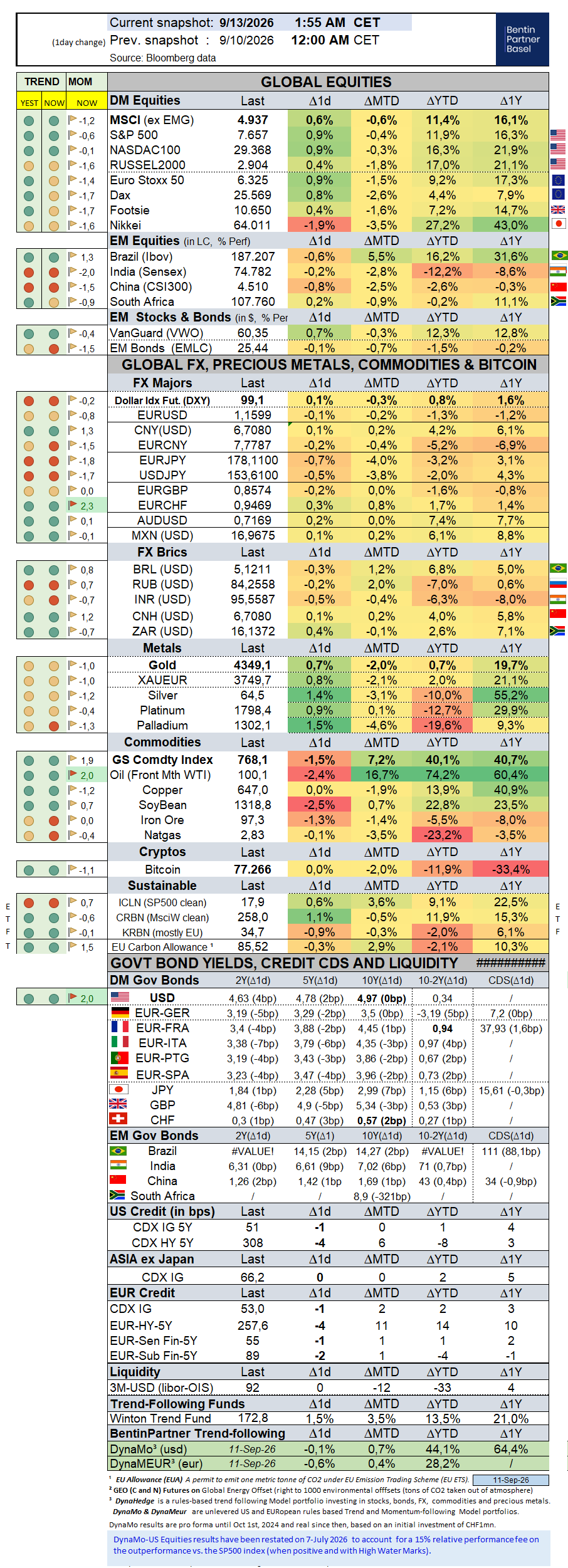
Over the past week, the S&P500 dropped -1,1% (12,1% YTD) while the Nasdaq100 dropped -0,4% (16,4% YTD). The US small cap index sold off by -2,1% (17,4% YTD). AAPL gained 1,2% (22,2%, Z-score 2,1).
The Equally Weighed SP500 sold off by -2,4% (12,2% YTD), underperforming the S&P500 by-1,2%. The median SP500 YTD return closed the week at 5,3%.
Cboe Volatility Index rallied 10,6% (6,0% YTD) to 15,84.
The Eurostoxx50 dropped -1,1% (11,4%), matching the S&P500.
Diversified EM equities (VWO) dropped -1,0% (12,3%), outperforming the S&P500 by 0,1%.
The Dollar DXY Index (UUP) measuring the USD performance vs. other G7 currencies gained 0,2% (3,8%) while the MSCI EM currency index (measuring the performance of EM currencies vs. the USD) dropped -0,1% (4,5%).
10Y US Treasuries underperformed with yields rising 18bps (80bps, Z-score 2,4) to 4,97%. 10Y Bunds climbed 17bps (65bps, Z-score 2,1) to 3,50%. 10Y Italian BTPs underperformed rising 20bps (80bps, Z-score 2,0) to 4,35%, underperforming Bunds by 3bps.
10Y French OAT's underperformed rising 26bps (89bps, Z-score 2,4) to 4,45%, underperforming Bunds by 9bps.
US High Yield (HY) Average Spread over Treasuries dropped -2bps (-1bps) to 2,65%. US Investment Grade Average OAS dropped -1bps (4bps) to 0,88%.
In European credit markets, EUR 5Y Senior Financial Spread climbed 2bps (1bps) to 0,55%.
Gold dropped -1,8% (0,7%) while Silver sold off by -2,6% (-10,0%). Major Gold Mines (GDX) sold off by -4,3% (13,2%).
Goldman Sachs Commodity Index rallied 3,8% (48,3%). WTI Crude rallied 9,6% (74,2%, Z-score 2,0).
Overnight in Asia…
S&P future -39 points; Hong Kong +0.3%; Nikkei -0.9%; China -0.3%
Stocks and futures retreated after major AI companies called for a slowdown in the technology’s development, raising concerns about a sector that has powered this year’s rally. Oil also rose on heightened middle east tensions.
SK Hynix Inc. and Kioxia Holdings tumbled more than 6% and 9% each, before paring some losses. Samsung Electronics also declined 4%, while SoftBank Group Corp.’s shares fell the most in nearly three months.
Sungrow Power Supply, one of the world’s largest renewable energy equipment makers, will raise product prices this month after higher raw material costs squeezed margins. Prices for inverters, energy storage converters and energy storage systems will increase by 5% to 15% effective Sept. 20, according to a letter the company sent to clients.
The locomotive of a passenger train traveling from Kyiv to Warsaw was hit by a Russian drone just kilometers from the Polish border on Sunday morning. The attack happened minutes after another train carrying European officials including former Swedish Prime Minister Carl Bildt and former UK Prime Minister Boris Johnson left the station on the way back from an annual conference in Kyiv.

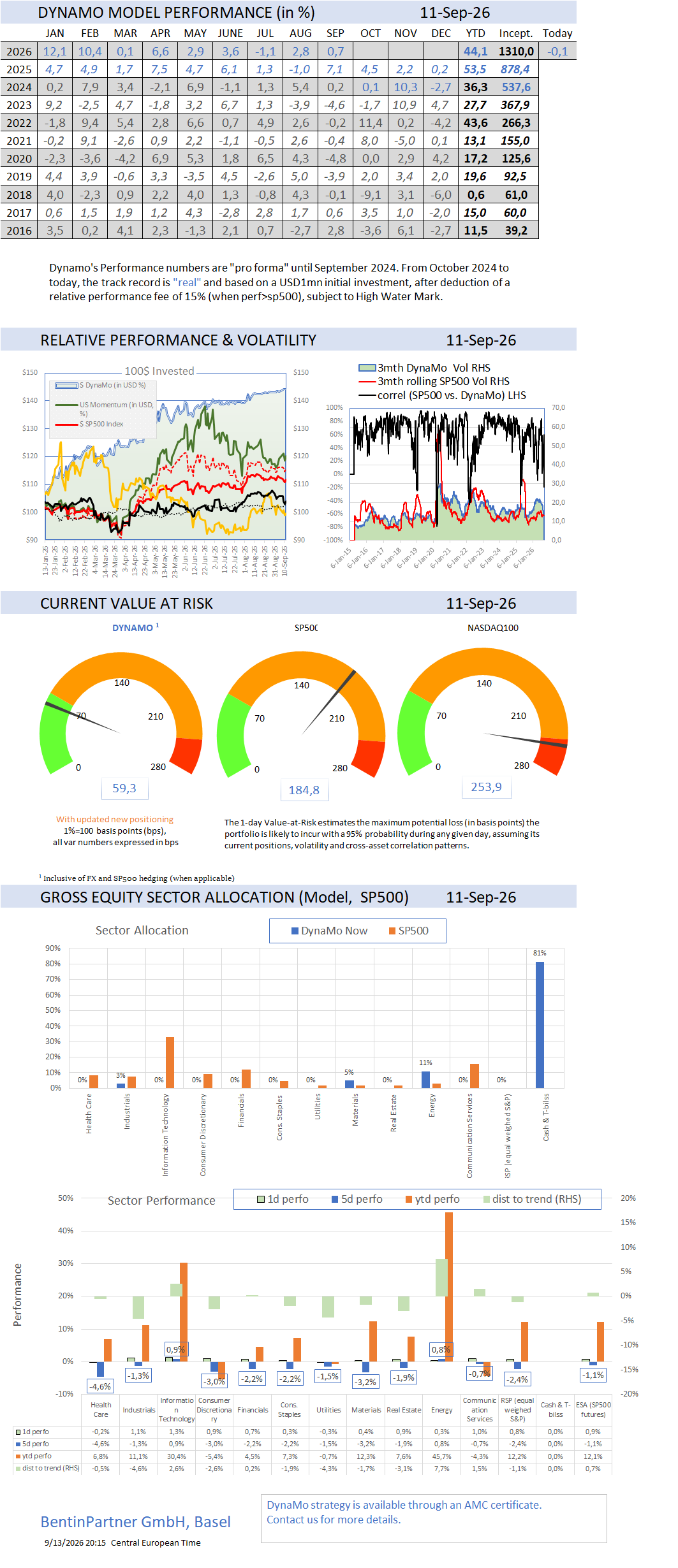
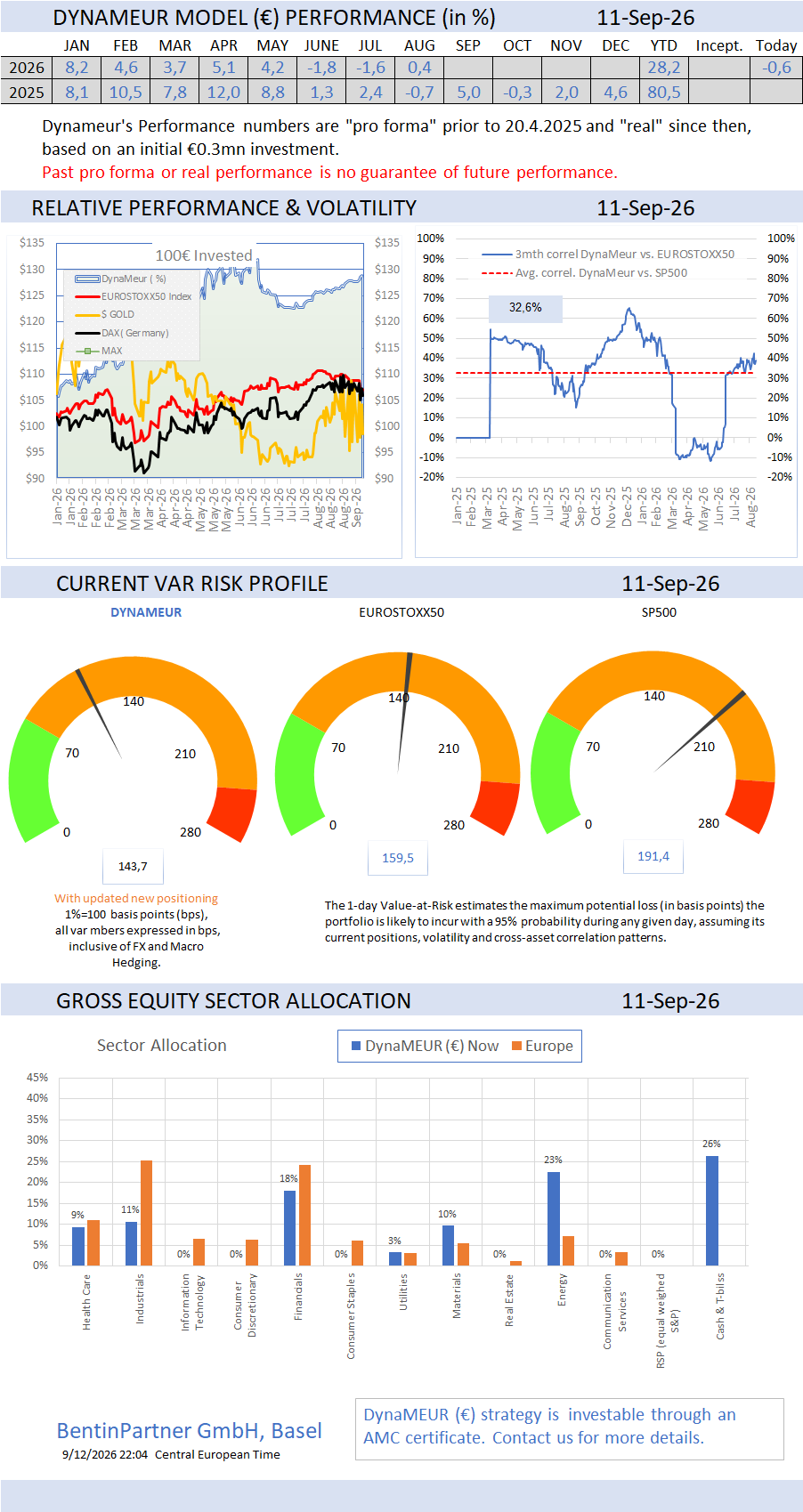
To learn more about our AMC offering and how to invest in the trend-following, visit our Advisory web page.
If you like our Weekly, you will love our Daily!
Consider a subscription today. Discounts may apply!
To learn more about us and how we can assist you, check our website
Important Disclaimer
© Copyright by BentinPartner LLC. This communication is provided for information purposes only and for the recipient's sole use. Please do not forward it without prior authorization. It is not intended as a recommendation, an offer, or solicitation for the purchase or sale of any security or underlying asset referenced herein or investment advice. Investors should seek financial advice regarding the suitability of any investment strategy based on their objectives, financial situation, investment horizon, and particular needs. This report does not include information tailored to any particular investor. It has been prepared without any regard to the specific investment objectives, financial situation, or particular needs of any person who receives this report. Accordingly, the opinions discussed in this report may not be suitable for all investors. You should not consider any of the content in this report as legal, tax, or financial advice. The data and analysis contained herein are provided "as is" and without warranty of any kind. BentinPartner LLC, its employees, or any third party shall not have any liability for any loss sustained by anyone who has relied on the information contained in any publication published by BentinPartner LLC. The content and views expressed in this report represent the opinions of Marc Bentin and should not be construed as a guarantee of performance with respect to any referenced sector. We remind you that past performance is not necessarily indicative of future results. Although BentinPartner LLC believes the information and content included in this report have been obtained from sources considered reliable, no representation or warranty, express or implied, is provided in relation to the accuracy, completeness, or reliability of such information. This Report is also not intended to be a complete statement or summary of the industries, markets, or developments referred to in the Report.
Comments