Smelling Blood...

BentinPartner Weekly

Dear Reader,
Please find below our latest Weekly Trend Report.
Have a nice start of the week.
Marc Bentin,
Bentinpartner GmbH
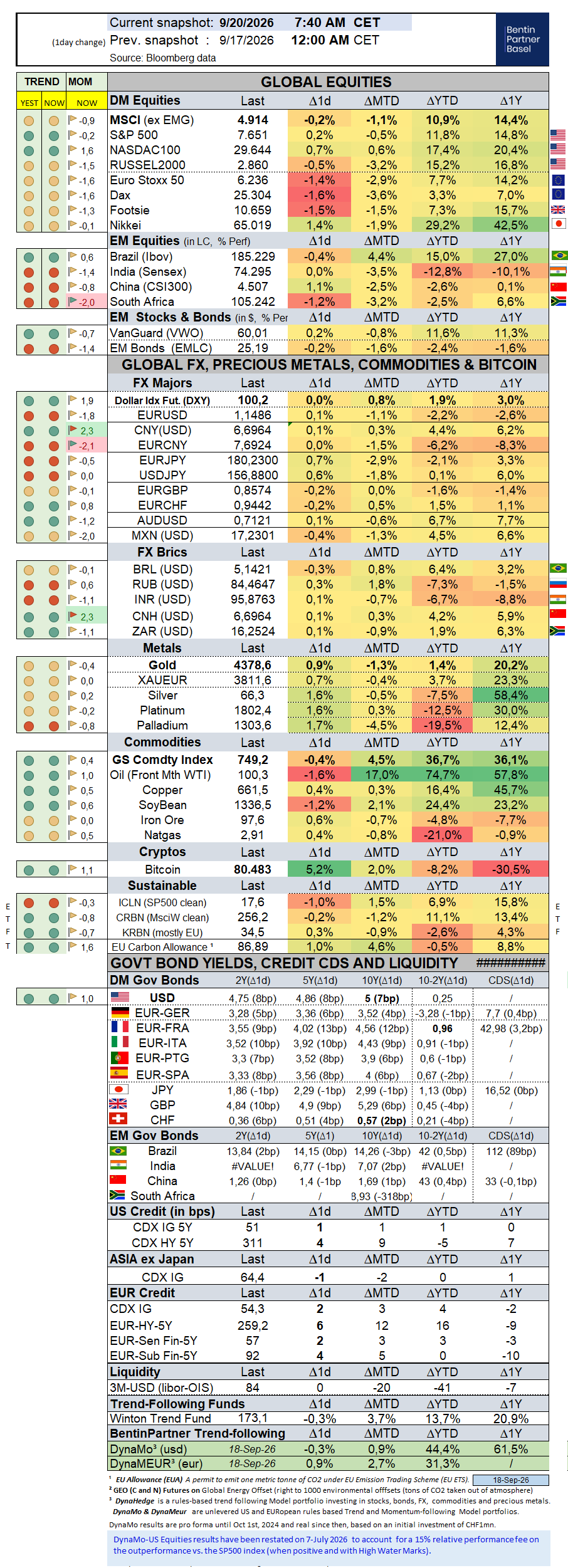
US stocks slipped early but ultimately recovered most of the initial sharp drop that followed what was, despite everything, a widely anticipated and unanimous Fed decision to raise rates by 25 bps to 4%. Fed Chair Warsh delivered a relatively hawkish and notably brief press conference. The Dow initially fell 1.2% on the announcement, and most S&P 500 sectors closed lower, although the Nasdaq ended largely unchanged, supported by modest gains in several AI names on the day of the Fed tightening. President Trump reacted by saying US rates should be at 1% or less.
Equities regained most of these losses later on Thursday (the Nasdaq 100 rose 1.7%, with Semis surging 3.1%). Intraday Friday, while most international equity markets traded lower, the MAG7 traded above the May 28th all‑time high, and the Nasdaq 100’s nearly 1% rally pushed YTD returns to 17.4%, with Semis and Biotechs reaching 68% and 31% respectively.
Despite this aggregate resilience, equities remained bifurcated: sectors rallying strongly one day were penalized the next, only to rebound again while previous winners lagged, a constant rotation that keeps investors off balance.
A growing cohort of analysts and market participants, ourselves included, has become more circumspect about valuations, AI‑bubble dynamics, the global war‑and‑energy backdrop, inflation, the debt overhang, rising default rates, FX and bond instability, and still‑fragile technicals. Yet some “weight lifting” in futures markets on the one index that matters most (the S&P 500) during illiquid overnight sessions is, in our view, not entirely unrelated to this resilience.
We saw what happened in Korea after the July AI rout, followed by a government bailout of over‑leveraged equity investors concentrated in memory chips. We saw Leopold’s situational‑awareness hedge fund bailed out by Citadel. And now market forces are “openly” facing a US Treasury Secretary who claims to possess “asymmetric” information and effectively “the house” in FX markets, not yet in bonds (impossible without QE), but certainly in the overnight US futures session, where USD 10–50 million can be enough to keep the index within a ±1% range, shaping sentiment when liquidity returns. We should abandon the notion that only FX and bond markets face intervention while equities remain untouched.
The US equity market has little room to fall when inflation is at 4% and rising, yields are at 5% and climbing, hyperscalers’ CDS and even sovereign spreads are blowing out, two wars are edging out of control, caution is being discarded, and midterms are approaching with impeachment risks in the background. It is, paradoxically, one of the most bullish “walls of worry” I have ever seen. Time to get unchained and succumb to FOMO perhaps… The idea seems to be to make skeptics doubt and capitulate. The problem is that preventing any correction only entrenches complacency and encourages further leverage.
While equities showed resilience, the international bond situation remained tense, and worsened, with Treasury yields closing at recent highs and yields elsewhere rising even more.
The bond market’s reaction to the Fed hike was not what was expected or hoped for: 10Y yields erased an initial advance but still closed a couple of bps higher at 5.02%, while 2Y yields rose 7 bps. The Fed’s message pushed expectations for another 25‑bps hike in October to 57% and for a December hike to 74%.
Fed Chair Kevin Warsh summarized the bond backdrop succinctly:
“First, economic strength… Second, competition for capital… hyperscalers are out raising funding… Third, geopolitics… hot spots around the world are driving long‑term yields. It’s not simply spot prices of energy…” Amen to that.
Markets continue absorbing extraordinary amounts of debt, while banks appear more willing to extend risky loans than even in 2007, analysts noted.
Elsewhere, French yields jumped another 11 bps to 4.57%, up 100 bps in three months — the highest since September 2008. Greek yields added 9 bps to 4.31%, and Italian yields gained 8 bps to 4.34%, both at multi‑year highs.
In credit markets, Apollo Global Management warned that corporate debt issued by hyperscalers powering the AI boom is getting riskier. CDS spreads are rising not because banks are hedging more, but because markets are repricing fundamentals: debt‑financed AI capex cycles with rising leverage, negative free cash flow, and uncertain payback on depreciating assets.
Another headline stood out: Fitch reported that the default rate for US private‑credit borrowers hit a record 6.3% in August across 1,300 borrowers, surpassing the previous 6.1% high. Fitch also recorded the highest monthly total of private‑credit default events in a year, driven by maturity‑extension transactions deemed defaults amid weak deal flow and difficulty selling struggling portfolio companies ahead of loan maturities.
The main beneficiary of the Fed decision was the dollar, which rallied broadly, pushing EURUSD down to 1.1460 from 1.1540. Most EM currencies weakened (except CNY, which is no longer an EM currency in any meaningful sense). FX volatility rose sharply. USDJPY traded at 153.40 on Monday and above 158 early Friday, perhaps suggesting S. Bessent needs a bigger house… JPY still lost 0.6% on Friday despite the BOJ rate increase. The MSCI EM Currency Index fell 0.9% last week, its worst week since May.
Geopolitical factors and US weaponization of the dollar were supposed to push investors away from USD assets. Foreign governments are repatriating gold from US vaults. Nearly two years into Trump’s second term, the world is understandably seeking distance from America.
Yet King Dollar still rules, up 5% YTD, supported by high yields, strong absolute and relative equity performance, and flows, justified or not, as well as the prospect of a European debt crisis the US now openly hopes to “outrun” as a path to lower long‑term yields.
Hedge funds smell blood, shorting EU bonds, encouraged by US investment‑bank recommendations (Morgan Stanley’s call to short Belgian debt was clearly not idiosyncratic). Meanwhile, mainstream parties across Europe are losing elections, some being wiped out (as seen in Germany this weekend), after pursuing economic, social, ideological, and geopolitical policies perceived as suicidal by much of the population.
In this context, and in my view, the USD is only worth shorting at this stage, against is CNY, certainly not against EUR, barely against JPY and possibly not against CHF either which has been trending lower for a while, penalized by a rising differential and increasingly EU friendly policies that are threatening the preservation of what has made Switzerland a successful and elite country, namely, the unconditional support for a political system that gives the last word to its people (not to ever be overwhelmed by an increasingly lawless and autocratic Commission, disrespectful of its own treaties) and cherish the sacrosanct Neutrality that earned the respect and the envy of the entire world...
Precious metals enjoyed a strong week with gold rallying nearly 2% and silver 5%.
Moving on to this week, business surveys for Europe and Japan and US manufacturing data will be released on Wednesday.
US and Chinese leaders will meet on Thursday where everything from tariffs, Chinese rare earth curbs and …AI should be discussed.
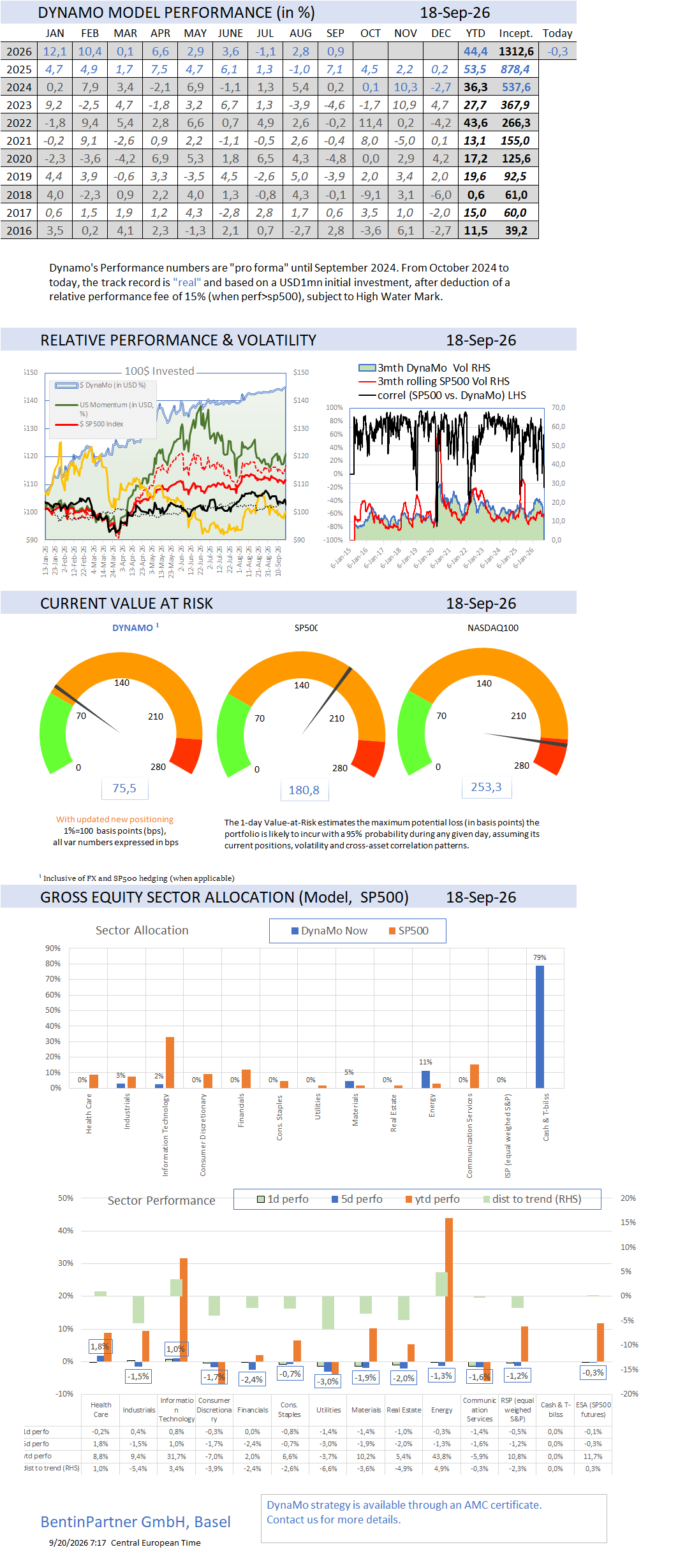
Over the past week, the S&P500 dropped -0,3% (11,7% YTD) while the Nasdaq100 gained 0,9% (17,4% YTD). The US small cap index dropped -1,7% (15,4% YTD). AAPL gained 1,2% (23,6%).
The Equally Weighed SP500 dropped -1,2% (10,8% YTD), underperforming the S&P500 by -0,9%. The median SP500 YTD return closed the week at 5,5%.
Cboe Volatility Index sold off by -6,5% (-0,9% YTD) to 14,81.
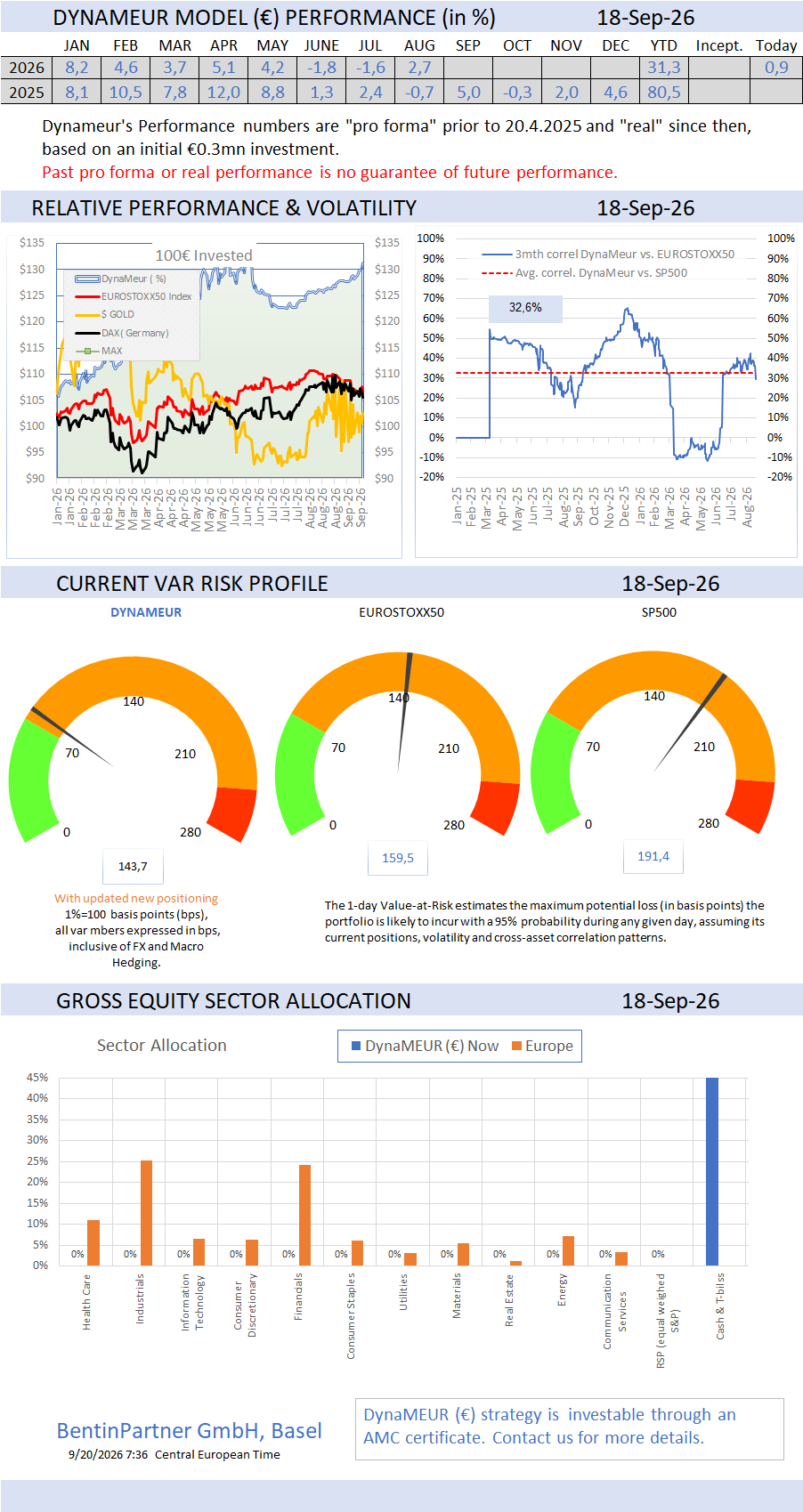
The Eurostoxx50 dropped -1,4% (9,8%), underperforming the S&P500 by -1,1%.
Diversified EM equities (VWO) dropped -0,6% (11,6%), outperforming the S&P500 by -0,2%.
The Dollar DXY Index (UUP) measuring the USD performance vs. other G7 currencies gained 1,1% (5,0%) while the MSCI EM currency index (measuring the performance of EM currencies vs. the USD) dropped -0,5% (3,7%).
10Y US Treasuries dropped 3bps (83bps) to 5,00%. 10Y Bunds climbed 2bps (66bps) to 3,52%. 10Y Italian BTPs underperformed rising 8bps (88bps) to 4,43%, underperforming Bunds by 6bps.
10Y French OAT's underperformed rising 11bps (100bps) to 4,57%, underperforming Bunds by a notable 9bps.
US High Yield (HY) Average Spread over Treasuries climbed 2bps (1bps) to 2,67%. US Investment Grade Average OAS dropped -3bps (1bps, Z-score -2,3) to 0,85%.
In European credit markets, EUR 5Y Senior Financial Spread climbed 1bps (3bps, Z-score 2,0) to 0,57%.
Gold gained 1,8% (1,4%) while Silver rallied 5,4% (-7,0%). Major Gold Mines (GDX) dropped -1,7% (11,3%).
Goldman Sachs Commodity Index dropped -0,7% (47,3%). WTI Crude sold off by -3,2% (71,0%).
Overnight in Asia…
S&P future +31points; Hong Kong +0.5%; Nikkei +1.3%; China +0.2%
Stocks rose and futures pointed to more gains after the US described talks with China as “very successful” ahead of a summit between Presidents Donald Trump and Xi Jinping.
Ukraine launched a major overnight drone strike on Russia, hitting a Moscow refinery despite President Trump's request for Ukraine to stop striking Russian energy infrastructure as a global refining crisis deepens. A report last Tuesday said Moscow was already considering extending its diesel export ban, while Senate Majority Leader John Thune told reporters that day he was "open to exploring" a US diesel export ban. Oil “dropped” on the news overnight and hopefully this
manipulationmarket action will soon translate on diesel prices.Friedrich Merz said he would stay put as German chancellor even after his party suffered its worst-ever result in a state election, with a tally showing the conservatives crashing out of a regional assembly for the first time in the country’s post-World War II history, Bloomberg reported. The CDU won 4.9% of the vote in Mecklenburg-Western Pomerania, just missing a 5% threshold required to enter parliament, while the Alternative for Germany won the contest with 38.2%. Merz's leadership is being questioned after the election, with some party officials convinced that his stewardship can only do more harm, and he will meet with party leaders and lawmakers to discuss the situation, Bloomberg also noted.

To learn more about our AMC offering and how to invest in the trend-following, visit our Advisory web page.
If you like our Weekly, you will love our Daily!
Consider a subscription today. Discounts may apply!
To learn more about us and how we can assist you, check our website
Important Disclaimer
© Copyright by BentinPartner LLC. This communication is provided for information purposes only and for the recipient's sole use. Please do not forward it without prior authorization. It is not intended as a recommendation, an offer, or solicitation for the purchase or sale of any security or underlying asset referenced herein or investment advice. Investors should seek financial advice regarding the suitability of any investment strategy based on their objectives, financial situation, investment horizon, and particular needs. This report does not include information tailored to any particular investor. It has been prepared without any regard to the specific investment objectives, financial situation, or particular needs of any person who receives this report. Accordingly, the opinions discussed in this report may not be suitable for all investors. You should not consider any of the content in this report as legal, tax, or financial advice. The data and analysis contained herein are provided "as is" and without warranty of any kind. BentinPartner LLC, its employees, or any third party shall not have any liability for any loss sustained by anyone who has relied on the information contained in any publication published by BentinPartner LLC. The content and views expressed in this report represent the opinions of Marc Bentin and should not be construed as a guarantee of performance with respect to any referenced sector. We remind you that past performance is not necessarily indicative of future results. Although BentinPartner LLC believes the information and content included in this report have been obtained from sources considered reliable, no representation or warranty, express or implied, is provided in relation to the accuracy, completeness, or reliability of such information. This Report is also not intended to be a complete statement or summary of the industries, markets, or developments referred to in the Report.
Comments