Europe is Losing It...and Much More

Updated: Dec 13, 2025
BentinPartner Weekly

Dear Reader,
Please find below our latest Weekly Trend Report.
Have a nice start of the week.
Marc Bentin,
Bentinpartner GmbH
US stocks ticked higher for another week, led by strength in tech and utilities, leaving stocks very close to record highs, despite the recent bout of volatility.
On the economic side, US consumer spending stalled in September (following a downwardly revised 0.2% advance in August), , suggesting Americans were already stretched going into the government shutdown in the face of stubborn inflation.
Particularly noteworthy this year and following the recent correction, has been professional investors lagging private investors who accumulated gains from owning (more) tech and AI plays in particular.
In this context, a Santa Claus rally is more likely than not, in our view, especially during a week that will see the Fed delivering an interest rate cut and possibly some more (see bond comment below).
That being said, Goldman also wrote…”“Young Americans are increasingly planning for retirement by investing in the stock market while putting off homeownership. For decades, owning a home has helped Americans build their nest eggs. Gen Z hasn’t experienced a ‘protracted and more painful bear market’ like older investors have… ‘It’s not the norm to see a 20% drop and then a record climb back to all-time highs,’ he notes… That rebound might have given younger investors the takeaway that ‘buying the dip’ almost always pays and carries little risk.”
That is a risk for next year possibly, less than for the rest of the remaining of the year, in our view.
Risk appetite also returned to European stocks last week with Spain's Ibex 35 Index and Italy's FTSE MIB reaching record highs, led by bank shares (Europe’s best-performing sector so far this year, up 56% vs. 14% gain for the broad Eurostoxx600), helped by balance sheets being less leveraged, loan-to-deposit ratios below 100% and reliance on interbank and capital markets for funding being greatly reduced. EU lenders will kick off earnings season this week.
US Treasuries suffered their worst week in 8 months, with US 10 and 30Y yields climbing 12bps on the week despite 97% odds that the Fed will cut rates this week and softer job and retail sales data. There were also some voices on Wall Street expressing unease towards K. Hassett, the current NEC director, becoming the next leader of the US central bank, as hinted by D. Trump in recent days.
Possibly crippling bonds as well, hedge fund leveraging which has provided a critical source of demand for heavy government bond issuance in recent years (so far offsetting the diminishing appetite of the official sector), suddenly came under fresh regulatory scrutiny with pressure likely mounting on dealers to tighten “repo” securities financing.
In this context of tightening liquidity conditions, BoA advanced its forecast that besides cutting rates this Wednesday, the Fed is also likely to purchase USD50bn in US Tbills (whichever way such a decision would be called, QE or otherwise, shortly after ending the Fed’s QT program in December).
Japanese 10-year yields also jumped another 14 bps to 1.95%, the highest since July 2007.
The dollar dropped -0.5% last week.
Precious metals were mixed with gold dropping slightly and silver adding 3% while copper printed an all-time high (on tariff concerns) and natural gas jumped 9.1% to (+46% ytd) as natgas remains widely expected to have to plug the hole and meet ballooning future electricity demand. We also expect more gains before year end as investors prepare for next year.
The crypto market remained under high deleveraging pressure last week with recent headlines raising concerns about the borrowing undertaken by crypto treasury companies (MSTR). Of course, leverage in crypto can also be built into smart contracts and can arise without explicit borrowing. A MarketVector index tracking 50 mid- and micro-cap tokens has fallen nearly 70% this year, hitting its weakest level since early 2020. Altcoins have now shed $200 billion on paper since the market peaked. The retail tide that once lifted everything from Trump-branded coins to dog-theme tokens is no more, analysts reported, with some opining that it is early-innings for crypto deleveraging.
In contrast, private credit markers of stress improved last week (OWL), supported by insider buying and stocks regaining all time highs, in a context still fragilized by more than 1 in 10 private credit borrowers deferring cash interest payments and at least 45 firms being taken over by their lenders, the most in six years. Today, US private credit totals some $1.3 trillion, nearly half the $2.7 trillion in commercial and industrial loans made by commercial banks.
In Geopolitics, in a 33-page National Security Strategy signed by President D. Trump, the White House said Europe risked being wiped out unless it changed its politics and restores its cultural roots.
It is abundantly clear that the US and EU leadership now have radically different views.
Among the sternest criticisms the report noted that;
- “Continental Europe has been losing share of global GDP—down from 25 percent in 1990 to 14 percent today—partly owing to national and transnational regulations that undermine creativity and industriousness.”,
- “The larger issues facing Europe include activities of the European Union and other transnational bodies that undermine political liberty an sovereignty, migration policies that are transforming the continent and creating strife, censorship of free speech and suppression of political opposition, cratering birthrates, and loss of national identities and self-confidence.”
- “Should present trends continue, the continent will be unrecognizable in 20 years or less. As such, it is far from obvious whether certain European countries will have economies and militaries strong enough to remain reliable allies. Many of these nations are currently doubling down on their present path. We want Europe to remain European, to regain its civilizational self-confidence, and to abandon its failed focus on regulatory suffocation.”
- “Managing European relations with Russia will require significant U.S. diplomatic engagement, both to reestablish conditions of strategic stability across the Eurasian landmass, and to mitigate the risk of conflict between Russia and European states. It is a core interest of the United States to negotiate an expeditious cessation of hostilities in Ukraine, in order to stabilize European economies, prevent unintended escalation or expansion of the war, and reestablish strategic stability with Russia”.
- “The Trump Administration finds itself at odds with European officials who hold unrealistic expectations for the war perched in unstable minority governments, many of which trample on basic principles of democracy to suppress opposition. A large European majority wants peace, yet that desire is not translated into policy, in large measure because of those governments’ subversion of democratic processes. This is strategically important to the United States precisely because European states cannot reform themselves if they are trapped in political crisis.”
Of course, it is one thing to criticize Europe for its handling of the war in Ukraine and another one to admit a shared responsibility considering that the US through the (re)activation of the Monroe and past Brezinski doctrine for years immemorial actively sowed the seeds of this conflict.
It is in any case, abundantly clear from the above report (intensively relayed and commented over the week end) that the US and the EU leadership have now radically different views. In particular with a ridiculous bunch, and a 'trinity' of losers, all deeply unpopular at home, obsessively seeking legitimacy in war, to make their citizens forget the very real problems at home.
This is without forgetting the incompetence of the EU Commission leadership and diplomacy being increasingly marred in bribery scandals that should be added to the list of “shared values” put forward to justify the unconditional defense of Ukraine’s corrupt regime, at the EU taxpayers’ expense.
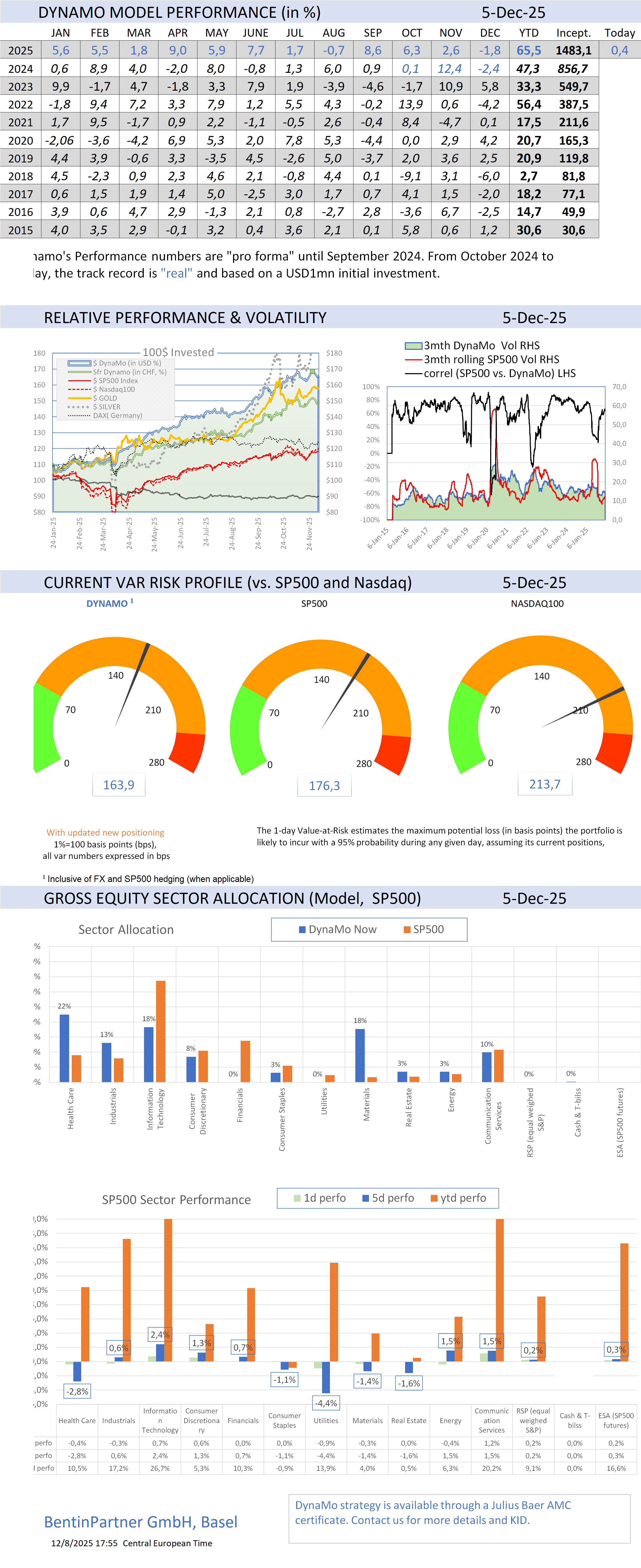
Over the past week, the S&P500 gained 0,3% (17,0% YTD) while the Nasdaq100 gained 1,0% (22,3% YTD). The US small cap index gained 0,8% (13,5% YTD). AAPL was unchanged (11,3%).
The Utilities sank 4.3% (up 14.4%). The Banks jumped 3.2% (up 24.8%)
The Equally Weighed SP500 gained 0,2% (9,6% YTD), underperforming the S&P500 by-0,1%. The median SP500 YTD return closed the week at 7,0%.
Cboe Volatility Index sold off by -5,7% (-11,2% YTD) to 15,41.
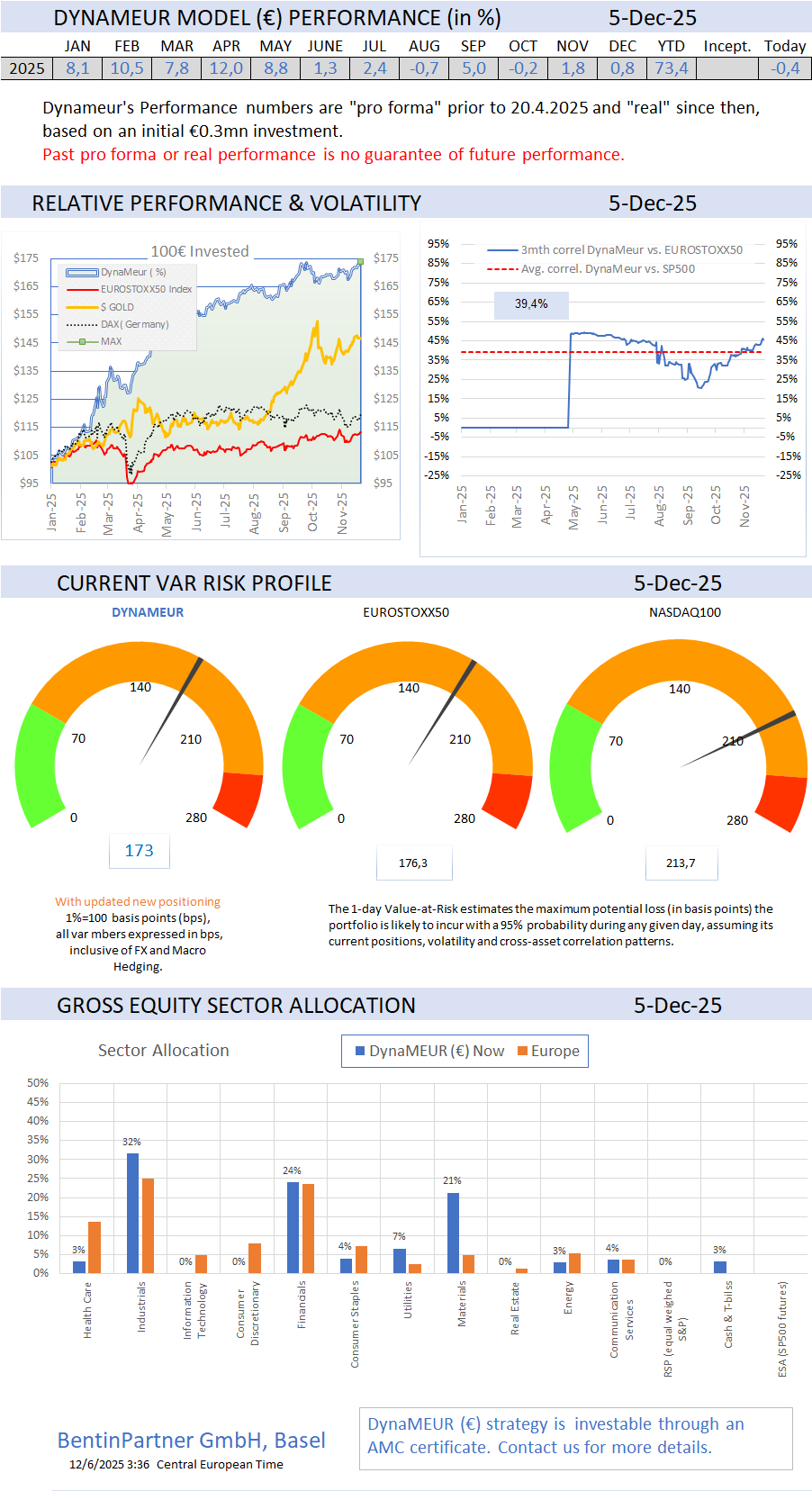
The Eurostoxx50 gained 0,9% (20,1%), outperforming the S&P500 by 0,6%.
Diversified EM equities (VWO) gained 0,2% (23,5%), outperforming the S&P500 by -0,2%.
The Dollar DXY Index (UUP) measuring the USD performance vs. other G7 currencies dropped -0,5% (-4,6%) while the MSCI EM currency index (measuring the performance of EM currencies vs. the USD) gained 0,1% (6,3%).
10Y US Treasuries underperformed with yields rising 12bps (-43bps) to 4,14%. 10Y Bunds climbed 11bps (43bps, Z-score 2,3) to 2,80%. 10Y Italian BTPs underperformed rising 9bps (-4bps) to 3,49%, outperforming Bunds by -2bps.
10Y French OAT's underperformed rising 11bps (33bps) to 3,52%, outperforming Bunds by 0bps.
US High Yield (HY) Average Spread over Treasuries dropped -5bps (-23bps) to 2,64%. US Investment Grade Average OAS dropped -4bps (-4bps) to 0,83%.
In European credit markets, EUR 5Y Senior Financial Spread dropped -1bps (-8bps) to 0,56%.
Gold dropped -1,0% (59,9%) while Silver rallied 3,3% (101,9%). Major Gold Mines (GDX) sold off by -2,6% (139,0%).
Goldman Sachs Commodity Index gained 1,2% (9,1%). WTI Crude rallied 2,6% (-16,2%).
Overnight in Asia…
Ø S&P future +12 points; Hong Kong -1.1%; Nikkei unch%; China +1.0%
Ø Asia stocks are inching higher following a strong US close and the US rate cut baked in expectations for this Wednesday. The dollar was marginally lower.
Ø Japan’s Q3 GDP suffered a deeper than expected contraction to -2.3% QoQ annualized (vs. -2% expected), mostly led by weaker business spending (-0.2% QoQ vs. +0.4% expected), giving some justification to PM TaKaichi’s stimulus package announced last month of USD114bn in fresh spending or the largest fiscal stimulus move since COVID.
Ø China trade surplus exceeded a record yoy USD1trn, following an unexpected drop last month, after exports rose 5.9% yoy (vs. 4% expected) whilst imports only rose 1.9% yoy, underscoring China’s difficulty to rebalance its economy in favor of domestic consumption. This occurred despite shipments to the US plummeting 29%, the 8th month of double digits decline and the biggest since August, highlighting the “offsetting” strong sales to Europe, Latin America and Africa…
Ø President Donald D. Trump said he’s disappointed in Ukrainian President Volodymyr Zelenskiy’s handling of a US proposal to end the war.
Ø Chinese and Japanese ties, already strained by PM Sanae Takaichi’s comments on Taiwan, came under further pressure this weekend after a Chinese fighter aircraft trained fire-control radar on Japanese military jets for the first time, Bloomberg reported.
Ø “Europe has a real problem,” Dimon said Saturday “They do some wonderful things on their safety nets. But they’ve driven business out, they’ve driven investment out, they’ve driven innovation out. “, he said.
Ø President Trump says the proposed Netflix and Warner Bros. deal would “create a big market share” and “could be a problem.”
Ø Yardeni Research now recommends effectively going underweight the MAG7 megacap technology stocks versus the rest of the S&P 500, expecting a shift in earnings growth ahead. The firm recommends market-weighting of the two sectors by adding to overweights in financials and industrials, and overweighting health care.
Ø Six European Union leaders including Italy’s Giorgia Meloni asked the European Commission to propose softening the bloc’s vehicle emission rules to halt a de-facto ban on combustion engines planned by the middle of the next decade.
Ø In an unusual move by a EU leader to comment on the region’s central bank, E. Macron, whose successive governments have been the most spendthrift among EU nations, driving his country on an unsustainable fiscal path, called for a change in approach to monetary policy at the ECB to boost the single market and protect it from the risks of financial crisis, meaning it can't let inflation be its sole objective, but also growth and employment.
Ø A plan by Switzerland’s right-wing People’s Party to cap the population at 10 million holds the backing of almost half the country, according to a poll before an expected vote next year, despite the government urging voters to reject it. According to the party’s proposal, the government would have to withdraw from international accords including its free-movement treaty with the European Union when the 10-million mark (currently 9-million) comes into sight, Bloomberg reported.

To learn more about our AMC offering and how to invest in the trend-following, visit our Advisory web page.
If you like our Weekly, you will love our Daily!
Consider a subscription today. Discounts may apply!
To learn more about us and how we can assist you, check our website
Important Disclaimer
© Copyright by BentinPartner LLC. This communication is provided for information purposes only and for the recipient's sole use. Please do not forward it without prior authorization. It is not intended as a recommendation, an offer, or solicitation for the purchase or sale of any security or underlying asset referenced herein or investment advice. Investors should seek financial advice regarding the suitability of any investment strategy based on their objectives, financial situation, investment horizon, and particular needs. This report does not include information tailored to any particular investor. It has been prepared without any regard to the specific investment objectives, financial situation, or particular needs of any person who receives this report. Accordingly, the opinions discussed in this report may not be suitable for all investors. You should not consider any of the content in this report as legal, tax, or financial advice. The data and analysis contained herein are provided "as is" and without warranty of any kind. BentinPartner LLC, its employees, or any third party shall not have any liability for any loss sustained by anyone who has relied on the information contained in any publication published by BentinPartner LLC. The content and views expressed in this report represent the opinions of Marc Bentin and should not be construed as a guarantee of performance with respect to any referenced sector. We remind you that past performance is not necessarily indicative of future results. Although BentinPartner LLC believes the information and content included in this report have been obtained from sources considered reliable, no representation or warranty, express or implied, is provided in relation to the accuracy, completeness, or reliability of such information. This Report is also not intended to be a complete statement or summary of the industries, markets, or developments referred to in the Report.
Comments