Treasuries Just Need to Outrun European Bonds...

BentinPartner Weekly

Dear Reader,
Please find below our latest Weekly Trend Report.
Have a nice start of the week.
Marc Bentin,
Bentinpartner GmbH
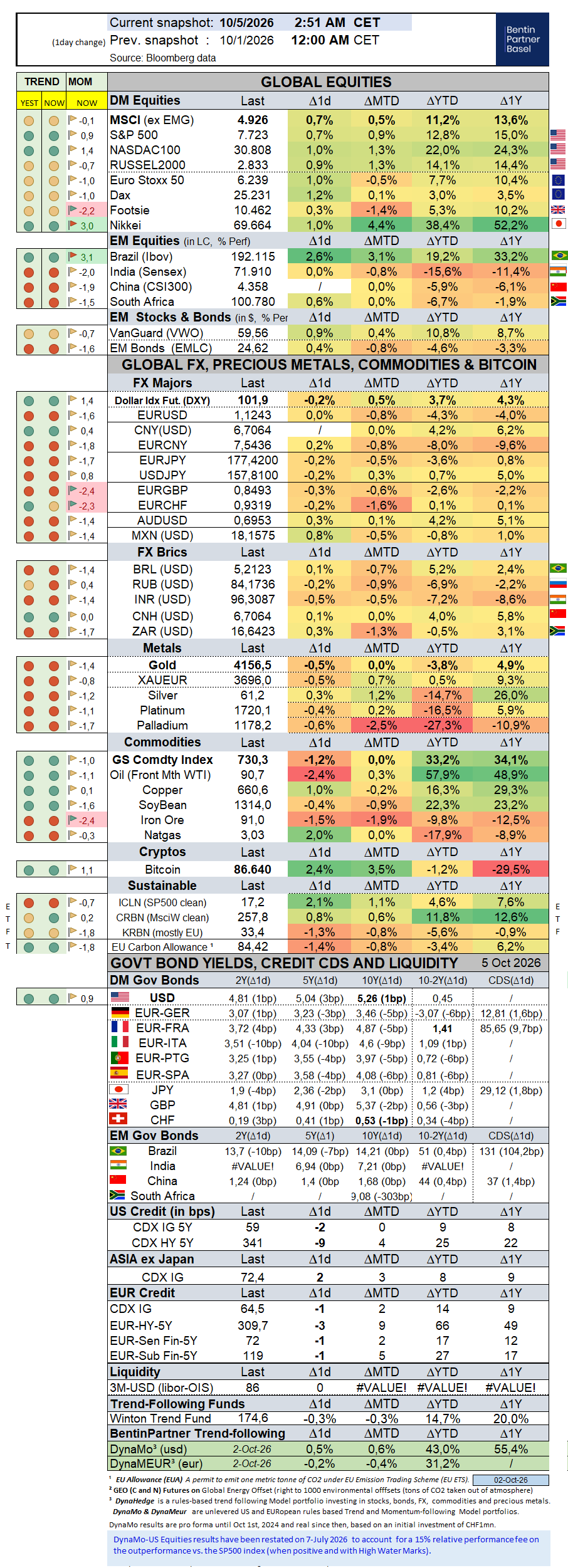
US (tech) stocks rallied further last week with Nvidia rallying another 3.9% on the week (supported artificially by a significant increase to its share buy-back program of USD235bn to be completed by 2028) and to a record high. With that, the Stoxx index again did most of the traction for the week while the MAG7 index also gained, stopping just short of September 21st all-time high on Friday.
On the data front, the ISM manufacturing index held steady at 54.5 but with a meaningful increase to its price component (which jumped from 6.8 to 77.9) to its highest level since the beginning of the Iran war.
However, Friday came with a nasty surprise showing the economy only added 29k non-farm payrolls in September (vs. 85k expected) with meaningful revisions ( -60k in total) brought to July and August job creation.
At the same time wage growth slowed to 3% while the unemployment rate rose to 4.2% (as the labor force increased).
This enabled US yields to briefly back off on Friday before heading back up to clos with 10Y US yield at 5.26% (+1bp on the day). While bonds lost their gains, stocks remained unfazed, taking bad news as good ones, as the poor job report help further reducing the odds of the FOMC raising rates this week (despite persistent inflation pressures), driving the Nasdaq and SP500 higher by respectively 1% and 0.7%.
While the SP500 closed the week with minor losses, the Nasdaq was propelled to fresh all-time highs. That being said the leadership of the equity market remained very narrow with tech shares seemingly behaving as if they are the only sector not sensitive to higher interest rates (which of course they are not, especially not now with the massive borrowing binge and massive debt pipeline loaded for years and trillions to come in the Ai space).
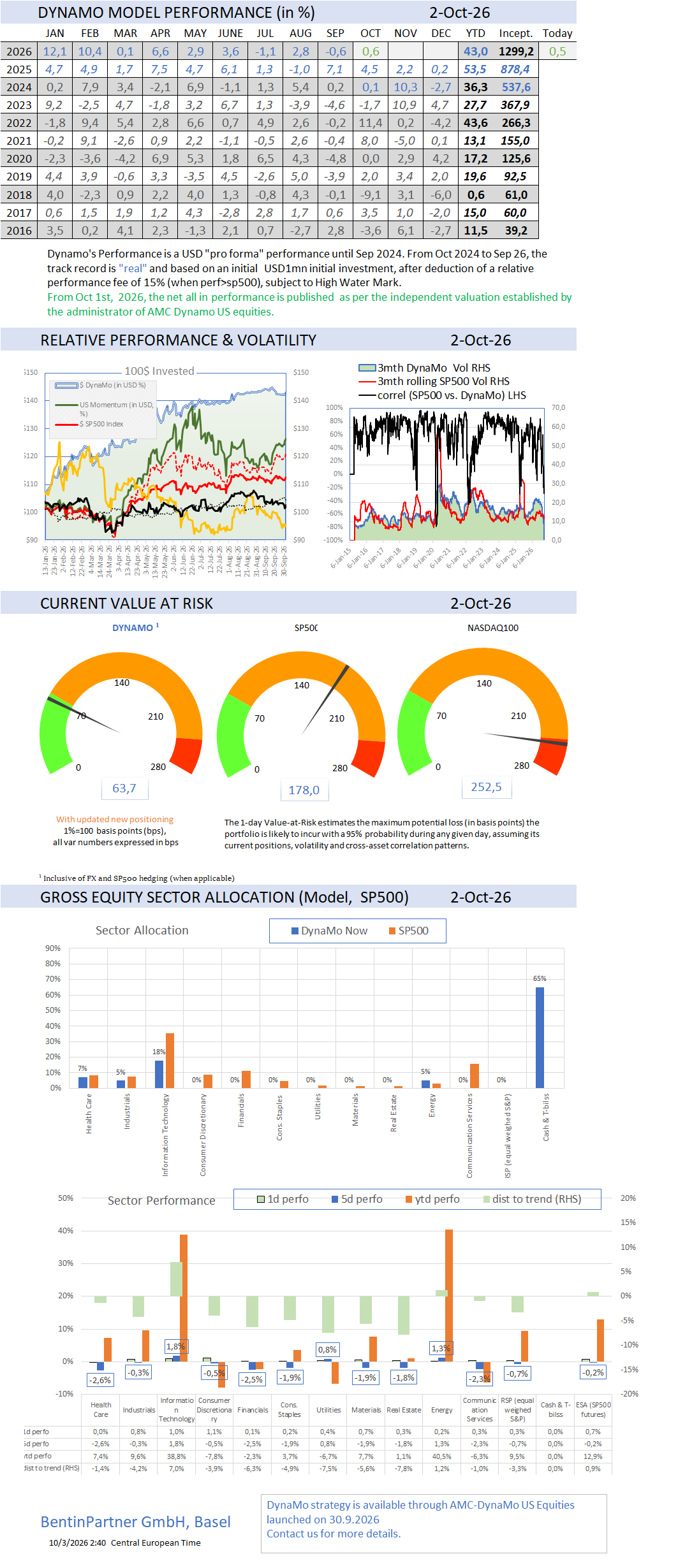
The SP500 itself is barely trending higher and could flip anytime trading close to technical supports (but likely won’t, if you ask me, more likely to be supported near term by a Fed which is now likely to stand pat in October and the hand of God likely to remain supportive going into the Midterms (the last thing D. Trump needs is an equity selloff into the Midterm elections…). Statistics are also on the side of October bull runs going into Midterms (with or without Trump) with the market going up more than 70% of the time.
That said, skeptics also took note that only the tech and energy sectors of the SP500 are still trending higher while all other sectors (9 out 11) are heading lower while the median SP500 share price barely stands positive for the year (hence with 50% of SP500 shares nursing losses for the year so far). Admittedly, the counterargument could be made that if breadth improve from now on, it will be very bullish…
So with that, if I was an economist, the best thing would be to tie one of my arms off…. And the best thing to do might remain to adapt more than to forecast….
Still, credit markets started to take notice and a further all-round steady deterioration in HY credit spreads (including the ORCL CDS and credit premium) was observed last week.
While the momentum in bonds and credit markets) remained poor, some bond market participants seemed to find solace in the fact that it is global as opposed to idiosyncratic bond market evolution. Sure enough in Europe, the widening yield differential between French (and Italian) bond yields to Bunds came as an alarm bell for some and as a solace for others, including S. Bessent…who held a more low-key stance in a recent interview, saying that the “the house cannot always win” and that “he cannot control bond markets, just slow them down”… Mhhh.
One hedge fund manager had this to say about the global bond markets….”US Treasuries will be fine. We just have to outrun European bonds…”. There is some truth to that of course as an EU debt crisis would automatically trigger, even if temporarily, flows into Treasuries. And probably the reason by S. Bessent is not worried about the French debt situation either, it seems.
For the week, Gold dropped 3.4% while the dollar continued to strengthen as tensions on the OAT/Bund spread taking its toll on the euro as well (which erased its gains vs. EUR for the year).
As regards the geopolitical situation, there was no good news to report on either conflict.
Russia sent NATO a written message, echoing statements issued by several Russian embassies in Europe last week which said that Moscow has “information that NATO is preparing (an) air and naval blockade of Kaliningrad and Kaliningrad region.”, saying it would use “all its arsenal, including nuclear weapons” if NATO attempted to cut off Kaliningrad. Kaliningrad is a Russian exclave on the Baltic Sea, cut off from mainland Russia and surrounded by NATO members Poland and Lithuania which Russia uses for transit.
In the meantime, Chancellor Mertz vowed to divert more funds away from the EU budget (including those earmarked in support of European farmers) to enforce more military buildup and financial support to Ukraine. So, it seems we are engaged into some sort of vicious circle of military escalation, encouraged by a Chancellor whose popularity and party representativity are falling into the abyss, which by itself makes for a particularly dangerous situation.
At the same time, the Iran conflict has sharply intensified with new US strikes, Iranian retaliation across the region, continued clashes in Hormuz where transit seems to have stalled sharply again along with diplomatic efforts...
For this coming week, today, the ISM services index will be released and scrutinized to see if inflation pressures spread to services while on Wednesday, the minutes of the last FOMC meeting will be released. All the more importantly, on Wednesday and an hour later, the 10Y auction will take place (hence with room for up and down surprises). Thursday’s jobless claims will be checked for confirmation that the US job market is weakening (195k expected).
Over the past week, the S&P500 dropped -0,2% (12,9% YTD) while the Nasdaq100 gained 0,7% (22,0% YTD). The US small cap index dropped -0,2% (14,4% YTD). AAPL sold off by -2,2% (22,7%).
The Equally Weighed SP500 dropped -0,7% (9,5% YTD), underperforming the S&P500 by-0,4%. The median SP500 YTD return closed the week at 4,1%.
Cboe Volatility Index rallied 3,0% (2,4% YTD) to 15,31.
The Eurostoxx50 dropped -1,0% (10,1%), underperforming the S&P500 by -0,8%.
Diversified EM equities (VWO) dropped -1,0% (10,8%), underperforming the S&P500 by-0,8%.
The Dollar DXY Index (UUP) measuring the USD performance vs. other G7 currencies gained 0,9% (6,9%) while the MSCI EM currency index (measuring the performance of EM currencies vs. the USD) dropped 0,0% (3,9%).
10Y US Treasuries underperformed with yields rising 11bps (110bps) to 5,27%. 10Y Bunds dropped -14bps (61bps) to 3,46%. 10Y Italian BTPs underperformed rising 10bps (106bps) to 4,61%, underperforming Bunds by 24bps.
10Y French OAT's underperformed rising 18bps (131bps) to 4,87%, underperforming Bunds by 32bps.
US High Yield (HY) Average Spread over Treasuries climbed 12bps (40bps) to 3,06%. US Investment Grade Average OAS climbed 3bps (8bps) to 0,92%.
In European credit markets, EUR 5Y Senior Financial Spread climbed 6bps (17bps) to 0,72%.
Gold sold off by -3,4% (-4,1%) while Silver sold off by -6,1% (-15,8%). Major Gold Mines (GDX) sold off by -5,5% (2,3%).
Goldman Sachs Commodity Index dropped -0,2% (45,5%). WTI Crude dropped -1,4% (58,7%).
Overnight in Asia…
S&P future +5 points; Hong Kong -0.1%; Nikkei+2.5%; China +0.3%
Flávio Bolsonaro surged to a surprise lead over Luiz Inácio Lula da Silva in the first round of Brazil’s presidential election, making him the overwhelming favorite to win the runoff and take Latin America’s heavyweight nation sharply to the right, Bloomberg noted.
The exodus of the uber-rich from the UK has become a $160 billion problem, with individuals tracked in the Bloomberg Billionaires Index loosening their ties with the UK or cutting them entirely in the past two years. That figure, calculated using data from the Bloomberg Billionaires Index, lays out for the first time the vast amounts of money and assets behind those quitting Britain.

To learn more about our AMC offering and how to invest in the trend-following, visit our Advisory web page.
If you like our Weekly, you will love our Daily!
Consider a subscription today. Discounts may apply!
To learn more about us and how we can assist you, check our website
Important Disclaimer
© Copyright by BentinPartner LLC. This communication is provided for information purposes only and for the recipient's sole use. Please do not forward it without prior authorization. It is not intended as a recommendation, an offer, or solicitation for the purchase or sale of any security or underlying asset referenced herein or investment advice. Investors should seek financial advice regarding the suitability of any investment strategy based on their objectives, financial situation, investment horizon, and particular needs. This report does not include information tailored to any particular investor. It has been prepared without any regard to the specific investment objectives, financial situation, or particular needs of any person who receives this report. Accordingly, the opinions discussed in this report may not be suitable for all investors. You should not consider any of the content in this report as legal, tax, or financial advice. The data and analysis contained herein are provided "as is" and without warranty of any kind. BentinPartner LLC, its employees, or any third party shall not have any liability for any loss sustained by anyone who has relied on the information contained in any publication published by BentinPartner LLC. The content and views expressed in this report represent the opinions of Marc Bentin and should not be construed as a guarantee of performance with respect to any referenced sector. We remind you that past performance is not necessarily indicative of future results. Although BentinPartner LLC believes the information and content included in this report have been obtained from sources considered reliable, no representation or warranty, express or implied, is provided in relation to the accuracy, completeness, or reliability of such information. This Report is also not intended to be a complete statement or summary of the industries, markets, or developments referred to in the Report.
Comments